
The Right-Sizing Era: Home Battery Capacity Halves as Australia’s Storage Boom Passes 490,000 Installs

Australia’s consumer energy transition is executing a dramatic shift in scale. One year after the federal government launched the $2.3 billion "Cheaper Home Batteries" scheme, the market has successfully adjusted from oversized, multi-megawatt-hour residential battery arrays to optimized, right-sized storage systems.
According to the latest market intelligence from energy consultancy SunWiz, total home energy storage installations through the federal rebate exceeded 490,000 systems by the end of July, bringing behind-the-meter capacity to over 13 Gigawatt-hours (GWh).
With roughly 2,000 new energy storage systems (ESS) coming online every week, Australia continues to lead the world in per-capita battery deployment—ranking third in total absolute numbers behind only the United States and China. However, beneath this volume surge lies a profound structural change in how households and commercial premises size their battery assets.
📉 From 50 kWh Monsters to the 20–30 kWh Sweet Spot
When the Cheaper Home Batteries scheme originally debuted, un-capped rebate settings incentivized households to install massive systems of 50 kWh and above. This rapid uptake consumed federal budget allocations at an unsustainable pace, leading to a temporary market slowdown in May when policymakers recalibrated the incentive structure.
To encourage sustainable, right-sized deployment, the federal government introduced a tiered rebate model:
Up to 14 kWh: Full upfront discount rate (approximately 30% off hardware costs).
14 kWh to 28 kWh: Tapered discount (60% of the baseline rate).
28 kWh to 50 kWh: Minimal discount (15% of the baseline rate).
The Market Response: Rebalancing Storage Capacity
The policy update has achieved its exact intended purpose. While total monthly registered capacity leveled off at 0.96 GWh (960 MWh) in July—down from April’s peak of 2.43 GWh—installation rates are climbing back rapidly as consumers adjust to the new incentives.
Battery System Size Band | July Market Dynamics | Key Driver |
20 kWh – 30 kWh | Grew 18% month-on-month (322 MWh added) | New #1 Segment: The optimal balance of daily solar self-consumption and evening grid independence under current rebates. |
40 kWh – 50 kWh | Declined 23% month-on-month (276 MWh added) | Sharp drop in demand due to the significant reduction in subsidies for oversized arrays. |
10 kWh – 20 kWh | Grew 5% month-on-month | Solid entry-level growth among standard residential solar households. |
30 kWh – 40 kWh | Grew 7% month-on-month | Steady adoption among high-demand residential and light-commercial properties. |
📍 State Performance: Victoria and WA Lead the Charge
Storage adoption profiles vary significantly across Australian jurisdictions based on local grid dynamics and state-level policy stacking:
Victoria: Maintains the highest average battery capacity in the country, sitting at 29.94 kWh per system. Victorian households continue to prioritize deep storage to offset winter heating electrification loads and volatile wholesale tariffs.
Western Australia: Hit a major landmark in July, surpassing 50,000 total home battery installations (adding over 1.1 GWh of storage to the South-West Interconnected System). WA’s rapid growth is driven by households stacking the federal rebate with the state's local Residential Battery Scheme, with suburban outer postcodes leading the state in deployment density.
💡 Right-Sizing Storage Assets: Why Precision Engineering Matters
The transition away from blanket-subsidized 50 kWh arrays highlights a critical truth in clean energy deployment: bigger is not always better.
Over-specifying a battery storage system bloats upfront capital expenditure, extends financial payback windows, and risks severe grid feed-in constraints from local Distribution Network Service Providers (DNSPs). Conversely, under-specifying a system leaves facility owners exposed to expensive evening peak power tariffs.
Achieving the perfect energy balance requires independent technical verification long before hardware is purchased.
🚀 De-Risk Your Battery Investment with EServices4U
Navigating battery storage options—whether for high-demand residential premises, commercial sites, or multi-site property portfolios—requires unbiased technical and financial oversight.
At EServices4U, we operate as your dedicated, independent Owner's Engineer and commercial energy consultancy. We don't sell retail batteries or push specific equipment brands; our sole mission is to ensure your clean energy assets are engineered for maximum financial return and total grid compliance.
How We Protect Your Project:
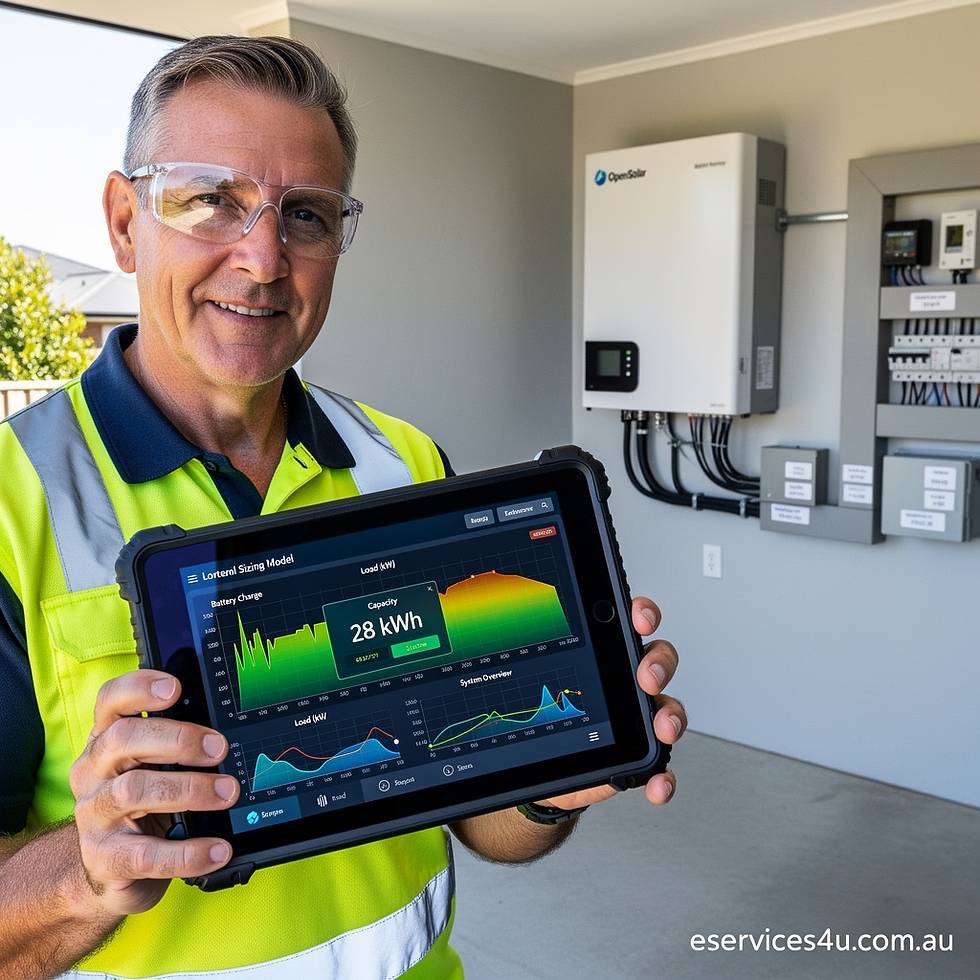
Advanced Load Modeling: We utilize sophisticated modeling software (including OpenSolar) to analyze your interval data, right-sizing your battery capacity to match your actual load profile under current rebate structures.
DNSP & Grid Compliance Audits: Our team reviews Single Line Diagrams (SLDs) and electrical schematics to ensure seamless network connection approvals with local grid operators.
Transparent Fixed-Fee Advisory: We operate on transparent, fixed-fee engineering review pricing tables, eliminating unexpected consulting markups and ensuring complete financial clarity.
While hiring an Owner's Engineer isn't mandatory, having an independent expert audit your system design is the single best way to ensure your battery asset delivers real, long-term ROI.
🌐 Website: eservices4u.com.au
📧 Email: growthpartner@eservices4u.com.au


