Hospital & Healthcare Arc Flash: The Hidden Danger Threatening Patient Safety in Australian Medical Facilities (And Why Your Biomedical Team Can't Fix This Alone)

Why Healthcare Facilities Face the Most Complex Arc Flash Risk Profile in Australia
Hospitals are not office buildings. They are not factories. They are not shopping centres. The electrical infrastructure inside an Australian hospital is arguably the most complex, most critical, and most dangerous of any building type in the country.
The 7 Factors That Make Hospital Arc Flash Risk Unique
Factor #1: 24/7 Critical Power — Zero Tolerance for Outages
A hospital cannot lose power. Not for a second. Lives depend on continuous electrical supply to:
Ventilators and anaesthetic machines in operating theatres and ICU
Incubators and radiant warmers in NICU and special care nurseries
Infusion pumps and syringe drivers delivering life-sustaining medications
Cardiac monitors and defibrillators in coronary care and emergency
Medical imaging equipment (CT, MRI, angiography) during procedures
Blood bank refrigeration maintaining temperature-critical blood products
Pharmacy automated dispensing systems controlling medication access
Fire detection, smoke control, and emergency lighting systems
Medical gas systems (oxygen, medical air, nitrous oxide, vacuum) that rely on electrical compressors and alarms
Data and communications infrastructure supporting electronic medical records
This means hospital electrical systems are designed with multiple redundant power sources — grid supply, backup generators, UPS systems, and sometimes solar and battery storage — all interconnected through complex automatic transfer switching arrangements. Every one of these interconnection points is a potential arc flash hazard.
Factor #2: Multiple Parallel Generation Sources
A typical major Australian hospital operates:
Grid supply from the local DNSP (Energex, Ausgrid, AusNet, Western Power, SA Power Networks) — often dual-feed from two separate zone substations for redundancy
2-4 backup diesel generators ranging from 500kW to 3MW each, capable of paralleling with each other and with the grid
Multiple UPS systems (typically 50kVA-500kVA each) protecting critical loads during the 10-15 second generator start-up period
Increasingly, rooftop solar PV arrays (100kW-1MW) and battery energy storage systems (BESS) as hospitals pursue net-zero targets
When all these sources are connected to the same switchboard — which happens during generator testing, grid paralleling, and emergency changeover — the cumulative fault current can be significantly higher than any single source alone.
Example: A major Brisbane hospital with dual 11kV grid feeds (25kA each), three 2MW generators (15kA combined), and a 500kVA UPS (8kA contribution) can see fault currents exceeding 45 kA on the main 415V essential bus during paralleled operation. This produces incident energy levels above 60 cal/cm² — well above the survivable threshold.
Most hospital electrical safety audits only assess the grid-connected scenario and completely miss the paralleled generation scenario where the real arc flash danger lies.
Factor #3: High-Density Switchboards in Confined Spaces
Hospital switchrooms are typically located in basements or service cores where space is at a premium. The result is:
Extremely high-density switchboards packed into small rooms with minimal clearance
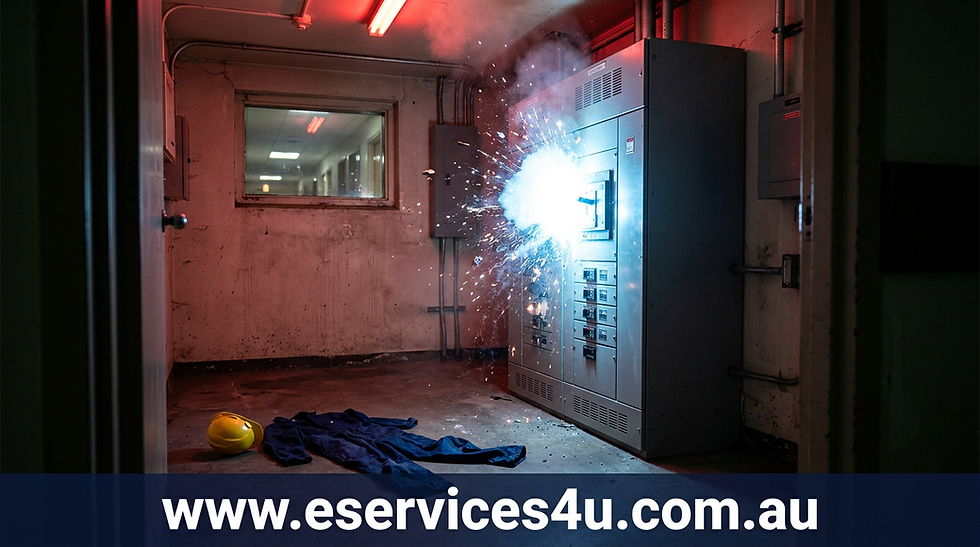
Arc flash boundaries that exceed the physical dimensions of the switchroom — meaning there is literally no safe standing position during live work
Limited escape routes in the event of an arc flash — a blast in a confined basement switchroom can trap workers with no path to safety
Proximity to critical infrastructure — hospital switchrooms are often adjacent to medical gas plants, water treatment systems, and communications rooms, meaning an arc flash can trigger cascading failures across multiple life-support systems
Factor #4: Ageing Infrastructure in Heritage Buildings
Many of Australia's major hospitals are housed in buildings that are 50-100+ years old, with electrical infrastructure that has been progressively modified, extended, and patched over decades:
Royal Brisbane and Women's Hospital (RBWH): Core infrastructure dating from the 1970s-1980s with multiple generations of switchboard additions
Royal Prince Alfred Hospital (RPA), Sydney: Buildings spanning from the 1880s to 2020s, with electrical systems of wildly varying age and condition
Royal Melbourne Hospital: Major campus with infrastructure from the 1940s through to recent redevelopments
Fiona Stanley Hospital, Perth: While newer (2015), already experiencing arc flash risks from rapid load growth and renewable energy integration
Royal Adelaide Hospital (new RAH): State-of-the-art facility (2017) with complex 33kV/11kV/415V distribution and integrated co-generation
The older the infrastructure, the higher the arc flash risk — degraded insulation, corroded connections, obsolete protective devices, and single-line diagrams that no longer reflect reality.
Factor #5: Medical Gas Systems and Explosive Atmospheres
Hospital switchrooms and electrical distribution pathways often run adjacent to or through areas containing medical gas systems:
Oxygen pipelines — an arc flash in the presence of elevated oxygen concentration can ignite materials that are normally non-flammable
Nitrous oxide — a powerful oxidiser that can accelerate combustion
Medical air compressors — generate heat and vibration that can degrade nearby electrical insulation
Anaesthetic gas scavenging systems — some older anaesthetic agents are flammable
An arc flash event that breaches a medical gas pipeline could trigger a secondary explosion or fire that spreads through the hospital's gas distribution network, threatening patient areas far from the original electrical fault.
Factor #6: Maintenance Windows Under Extreme Pressure
Hospital electrical maintenance is uniquely constrained:
Operating theatres cannot be shut down during surgical lists — maintenance must occur overnight or on weekends
ICU and NICU cannot tolerate any power interruption — live work is often the only option
Emergency departments operate 24/7 with unpredictable patient surges
Medical imaging suites have tightly scheduled patient bookings that cannot be disrupted
Budget constraints in public hospitals mean maintenance is often deferred until equipment fails
The result is that hospital electricians frequently perform live work on energised switchboards under extreme time pressure, often at 2 AM, often fatigued, often without adequate arc-rated PPE because the hospital's procurement department doesn't understand the requirement.
Factor #7: Regulatory Complexity and Accreditation Risk
Australian hospitals operate under a uniquely complex regulatory framework that most electrical consultants don't fully understand:
AS/NZS 3003 (Electrical Installations — Patient Areas) — the primary standard for electrical safety in healthcare, with specific requirements for cardiac-protected and body-protected areas
AS/NZS 3000 (Wiring Rules) — the overarching electrical safety standard
AS/NZS 4836 (Safe Working on Low-Voltage Installations) — arc flash risk assessment requirements
WHS Act and Regulations — duty of care for workers and patients
ACSQHC National Safety and Quality Health Service (NSQHS) Standards — particularly Standard 5 (Comprehensive Care) and Standard 6 (Communicating for Safety), which require safe clinical environments
State health department infrastructure guidelines — e.g., Queensland Health's Hospital and Health Service Infrastructure Planning Guidelines, NSW Health's Engineering Services and Sustainable Development Policy
Electrical Safety Act 2002 (QLD) + RPEQ requirements — mandatory for Queensland healthcare facilities
A hospital that fails an arc flash compliance audit risks not only WHS prosecution but also loss of accreditation — which can result in loss of Medicare funding and the effective closure of the facility.
The Healthcare Arc Flash Risk Spectrum: Every Facility Type
🏥 Major Tertiary Hospitals (Highest Risk)
Locations: Royal Brisbane & Women's Hospital, Princess Alexandra Hospital, Mater Hospitals (Brisbane), Royal Prince Alfred, Westmead, St Vincent's, Royal North Shore (Sydney), Royal Melbourne, Alfred, Austin, Monash Medical Centre (Melbourne), Fiona Stanley, Royal Perth, Sir Charles Gairdner (Perth), Royal Adelaide, Flinders Medical Centre (Adelaide), Canberra Hospital, Royal Hobart, Royal Darwin
Arc flash profile: 33kV/11kV/415V distribution networks with multiple parallel generators, UPS systems, and increasingly solar/BESS. Fault currents up to 50kA+. Incident energy levels of 40-80+ cal/cm² on main essential switchboards. Confined basement switchrooms. 24/7 live work under extreme pressure.
Regulatory exposure: ACSQHC accreditation, state health department oversight, WHS enforcement, RPEQ compliance (QLD).
🏥 Regional Hospitals (High Risk, Lower Resources)
Locations: Townsville University Hospital, Mackay Base Hospital, Cairns Hospital, Rockhampton Hospital, Bundaberg Hospital, Toowoomba Hospital, Newcastle's John Hunter Hospital, Wollongong Hospital, Geelong University Hospital, Ballarat Base Hospital, Bendigo Hospital, Bunbury Regional Hospital, Kalgoorlie Health Campus, Mount Gambier Hospital
Arc flash profile: 11kV/415V distribution with 1-2 backup generators. Older infrastructure (1970s-1990s). Limited on-site electrical engineering expertise. Maintenance often performed by external contractors unfamiliar with site-specific fault levels. Lower fault currents than tertiary hospitals but still dangerous (15-30kA).
Regulatory exposure: Same accreditation and WHS requirements as tertiary hospitals, but with fewer resources to achieve compliance.
🏥 Private Hospitals and Day Surgeries (Moderate-High Risk)
Locations: Ramsay Health Care facilities (Greenslopes, St Andrew's, Hollywood, Joondalup, St George, Westmead Private), Healthscope facilities (Gold Coast Private, Knox Private, Epworth, Cabrini), Ramsay and Healthscope networks across all states
Arc flash profile: 11kV/415V or 415V-only distribution. Smaller generators (200kW-1MW). Often housed in converted commercial buildings with non-purpose-built switchrooms. Rapid expansion and renovation creating undocumented electrical modifications. Pressure to minimise maintenance downtime due to surgical scheduling.
Regulatory exposure: ACSQHC accreditation, WHS obligations, insurer requirements.
🏥 Aged Care Facilities (Moderate Risk, Growing Concern)
Locations: Estia Health, Regis, Bupa, Opal, Bolton Clarke, UnitingCare, Catholic Healthcare, Anglicare facilities across all states — particularly concentrated in Gold Coast, Sunshine Coast, Sydney North Shore, Melbourne Eastern Suburbs, Perth Northern Suburbs, Adelaide Eastern Suburbs
Arc flash profile: 415V distribution with small backup generators (50kW-200kW) and UPS systems for nurse call and emergency lighting. Lower fault currents but ageing infrastructure, limited maintenance budgets, and a vulnerable resident population that cannot be easily evacuated during a power outage or fire.
Regulatory exposure: Aged Care Quality and Safety Commission standards, WHS obligations, fire safety compliance. An arc flash fire in an aged care facility with immobile residents could be catastrophic.
🏥 Medical Centres and Specialist Clinics (Moderate Risk)
Locations: High-density medical precincts in Spring Hill (Brisbane), Macquarie Park (Sydney), East Melbourne, Nedlands (Perth), North Adelaide
Arc flash profile: 415V distribution, often in multi-tenant buildings with shared switchrooms. Dialysis clinics, radiation oncology centres, and day chemotherapy units have critical power requirements similar to hospitals but with far less electrical infrastructure oversight.
🏥 Pathology and Diagnostic Laboratories (Moderate-High Risk)
Locations: Sullivan Nicolaides, QML, Laverty, Dorevitch, Western Diagnostic, Clinipath facilities across all states
Arc flash profile: 415V distribution with UPS-protected refrigeration for temperature-critical specimens. An arc flash that destroys a pathology lab's refrigeration could compromise thousands of patient samples, delaying diagnoses and treatment.
🏥 Dental Clinics and Veterinary Hospitals (Lower Risk, Not Zero)
Locations: High-end dental practices and veterinary referral hospitals across capital cities
Arc flash profile: 415V distribution with small UPS systems. Lower fault currents but often housed in older commercial buildings with ageing switchboards.
The AS/NZS 3003 Gap: Why Your Medical Area Compliance Audit Doesn't Cover Arc Flash
This is the single biggest misconception in Australian healthcare electrical safety.
Most hospitals undergo regular AS/NZS 3003 compliance audits — typically every 1-2 years — conducted by biomedical engineering teams or specialist healthcare electrical consultants. These audits focus on:
✅ Line isolation monitors (LIMs) in body-protected and cardiac-protected areas
✅ Equipotential earthing systems in operating theatres and ICU
✅ RCD testing and response times
✅ Earth leakage and insulation resistance in patient areas
✅ Emergency lighting and essential supply changeover times
✅ UPS battery condition and runtime
What AS/NZS 3003 audits almost NEVER cover:
❌ Arc flash incident energy calculations at the main switchboard, essential switchboard, or generator switchboard
❌ Arc flash boundary distances in the switchroom
❌ Arc-rated PPE requirements for maintenance electricians
❌ Protective device coordination and clearing times
❌ Fault current contribution from parallel generators and UPS systems
❌ Arc flash labelling on switchboards
❌ Short-circuit duty verification of switchgear
AS/NZS 3003 is a patient safety standard. It does not address worker safety from arc flash. That falls under AS/NZS 4836 and the WHS Act — and it requires a completely separate engineering assessment that most hospitals have never commissioned.
The result: A hospital can be 100% compliant with AS/NZS 3003 for patient area electrical safety while simultaneously operating switchboards with lethal arc flash energy levels that could kill a maintenance electrician and trigger a cascading power failure that endangers patients.
E Services 4U bridges this gap. We provide integrated assessments that address both AS/NZS 3003 patient safety compliance AND AS/NZS 4836 / IEEE 1584 arc flash worker safety — in a single, RPEQ-signed report that satisfies your biomedical team, your facility management team, your WHS committee, and your accrediting body.
The Generator and UPS Arc Flash Risk That Nobody Talks About
Backup Generator Switchboards
Every Australian hospital above a certain size is required to have backup diesel generators that automatically start and pick up the essential load within 10-15 seconds of a grid failure. These generators are tested monthly — typically by simulating a grid failure and allowing the generator to parallel with the grid for a brief period before taking over the load.
The arc flash danger: During the paralleling period, the fault current at the essential switchboard is the sum of the grid fault current AND the generator fault current. This can be 30-50% higher than the grid-only scenario that most studies model.
Example: A hospital with 25kA grid fault current and 12kA generator fault current sees 37kA during paralleling. The arc flash incident energy increases from 18 cal/cm² (grid only) to 42 cal/cm² (paralleled) — pushing the board from Category 3 to Category 4 PPE, and potentially above the safe working limit.
If your arc flash study only modelled the grid-connected scenario, your labels are wrong, your PPE is inadequate, and your electricians are at risk during every monthly generator test.
UPS Systems
Hospital UPS systems are typically large, three-phase units (50kVA-500kVA) with significant battery banks. During a fault on the UPS output bus, the UPS inverter and battery bank can contribute substantial fault current — often 5-10kA for several cycles before the UPS internal protection clears.
The arc flash danger: UPS switchboards are often located in small, confined rooms adjacent to the main switchroom. An arc flash in a UPS room can:
Destroy the UPS, eliminating the critical 10-15 second bridge between grid failure and generator start-up
Release toxic gases from damaged lithium-ion or VRLA batteries
Trigger a fire that spreads to the adjacent switchroom
Cause an immediate loss of power to life-support equipment if the UPS was the sole supply during a grid outage
E Services 4U solution: Our healthcare arc flash studies model ALL operating scenarios — grid only, generator only, paralleled, UPS on battery, UPS on bypass, solar/BESS contribution — to identify the worst-case incident energy at every board under every possible configuration.
Real Australian Healthcare Electrical Incidents
Incident #1: The Melbourne Hospital Generator Fire (2019)
A major public hospital in Melbourne's inner suburbs experienced a catastrophic generator switchboard fire during a routine monthly test. The arc flash originated from a degraded connection on the 11kV generator bus that had not been thermally inspected in four years. The fire destroyed the generator switchboard and damaged the adjacent essential switchboard, causing a 45-minute partial power outage affecting operating theatres and ICU. Three surgeries were aborted. Two ICU patients required emergency manual ventilation. The hospital's insurer paid $4.1 million in property damage and business interruption claims but subsequently doubled the hospital's electrical insurance premium and mandated an IEEE 1584 arc flash study as a condition of continued coverage.
Incident #2: The Queensland Hospital NICU Near-Miss (2021)
A regional hospital in North Queensland experienced an arc flash on the 415V essential distribution board during a severe storm that caused multiple grid supply interruptions. The arc flash was triggered by moisture ingress into the switchboard enclosure — a known risk in tropical Queensland that had not been addressed because the switchboard's IP rating had degraded over 25 years of service. The essential supply was interrupted for 12 seconds, during which the NICU ventilators switched to internal battery backup. No patients were harmed, but the incident triggered a formal investigation by Queensland Health and a directive requiring all Hospital and Health Services in the region to complete arc flash assessments within 12 months.
Incident #3: The Sydney Private Hospital Accreditation Crisis (2022)
A large private hospital in Sydney's North Shore was preparing for its ACSQHC accreditation survey when the surveyors requested evidence of arc flash compliance under WHS Regulations. The hospital's facility manager could not produce an arc flash study, arc flash labels, or evidence of arc-rated PPE procurement. The surveyors issued a "Not Met" rating against NSQHS Standard 5.14 (Safe Clinical Environment), placing the hospital's accreditation at risk. The hospital was given 90 days to produce a compliant arc flash assessment or face potential loss of accreditation — which would have resulted in the loss of Medicare provider status and an estimated $15 million annual revenue impact.
Incident #4: The Perth Aged Care Electrical Fire (2023)
An aged care facility in Perth's northern suburbs experienced an electrical fire in the main switchboard that was later attributed to an arc flash caused by corroded busbar connections. The fire triggered the building's fire alarm and sprinkler system, requiring the emergency evacuation of 87 residents — many of whom were immobile, dementia patients, or on oxygen therapy. Two residents suffered smoke inhalation injuries. The facility was closed for 6 weeks during repairs, and the operator faced prosecution under the Aged Care Quality and Safety Commission standards and WHS legislation.
What a Healthcare-Specific RPEQ Arc Flash Study Includes
A hospital arc flash study is fundamentally different from a commercial or industrial study. The complexity of healthcare electrical systems, the criticality of the loads, and the regulatory overlay demand a specialised approach.
Phase 1: Healthcare Electrical System Modelling
Complete power system model from the DNSP point of supply to the furthest medical area distribution board
All voltage levels: 33kV (if applicable), 11kV, 415V, 240V
All generation sources: dual grid feeds, backup generators (all units), UPS systems (all units), solar PV, BESS, co-generation
All automatic transfer switches (ATS) and static transfer switches (STS)
All medical area isolation transformers and line isolation monitors
All essential, critical, and normal supply distribution paths per AS/NZS 3003 classification
Phase 2: Multi-Scenario Short-Circuit Analysis
Scenario A: Grid supply only (normal operation)
Scenario B: Single generator (emergency operation)
Scenario C: All generators paralleled (extreme emergency or testing)
Scenario D: Grid + generators paralleled (changeover period — highest fault current)
Scenario E: UPS on battery (grid and generator both failed)
Scenario F: UPS on bypass (maintenance mode)
Scenario G: Solar/BESS contribution (if applicable)
Equipment duty verification against rated short-circuit withstand for ALL scenarios
Phase 3: Protection Coordination Study
Time-current coordination of all protective devices from DNSP metering to medical area final sub-circuits
Special attention to ATS changeover timing and generator synchronisation protection
Verification that essential supply protection coordinates with upstream DNSP protection
Assessment of medical area RCD coordination with upstream overcurrent protection
Identification of coordination gaps that could extend arc flash duration or cause unnecessary tripping of essential loads
Phase 4: Arc Flash Incident Energy Calculations (IEEE 1584-2018)
Incident energy calculation at every switchboard, panel, ATS, generator paralleling board, and UPS distribution board
Calculations performed for ALL operating scenarios (A through G above)
Worst-case scenario identification for each board (typically Scenario D: paralleled operation)
Arc flash boundary determination for all working locations
PPE category assignment per NFPA 70E
Identification of boards exceeding 40 cal/cm² (no safe live work)
Special assessment of confined switchroom spaces where arc flash boundary exceeds room dimensions
Phase 5: Healthcare-Specific Risk Assessment
Patient impact analysis: What happens to critical loads if an arc flash trips the essential supply?
Cascading failure analysis: Could an arc flash in the main switchroom trigger failures in medical gas, fire protection, or communications systems?
Evacuation impact assessment: Could an arc flash fire or smoke event compromise patient evacuation routes?
Medical gas interaction assessment: Proximity of switchboards to oxygen and nitrous oxide pipelines
Maintenance scheduling recommendations: When can live work be performed with minimum patient risk?
Phase 6: Arc Flash Labelling
Weatherproof, hospital-grade labels suitable for clean-room and clinical environments
Labels for all switchboards from 11kV to 415V
Labels include: incident energy (worst-case scenario), arc flash boundary, PPE category, shock boundaries, upstream device, study date, RPEQ number
Colour-coded labels indicating patient impact level (red = critical loads affected, amber = essential loads affected, green = normal loads only)
Phase 7: Healthcare-Specific Deliverables
ACSQHC Compliance Summary: Mapping of arc flash study findings to NSQHS Standards 5 and 6
Biomedical Engineering Integration Report: Recommendations for coordinating arc flash safety with AS/NZS 3003 medical area compliance
Emergency Power Restoration Procedures: Step-by-step procedures for restoring essential power after an arc flash event
Contractor Safety Induction Pack: Site-specific arc flash safety information for external electrical contractors
PPE Procurement Specification: Exact arc-rated PPE requirements by board and scenario
Maintenance Mode Recommendations: Arc flash reduction configurations for planned maintenance activities
RPEQ-Signed Report: Comprehensive engineering report signed by a Registered Professional Engineer of Queensland
The Accreditation Connection: Why ACSQHC Surveyors Are Now Asking About Arc Flash
The Australian Commission on Safety and Quality in Health Care (ACSQHC) administers the National Safety and Quality Health Service (NSQHS) Standards, which all Australian hospitals and day procedure services must meet to maintain accreditation.
While the NSQHS Standards do not explicitly mention "arc flash" by name, several standards create implicit requirements that surveyors are increasingly interpreting as requiring arc flash compliance:
NSQHS Standard 5: Comprehensive Care
Action 5.14: Requires organisations to "identify and manage risks to patient safety associated with the clinical environment"
Surveyor interpretation: An arc flash event that interrupts essential power to patient care areas is a clinical environment risk that must be identified and managed
NSQHS Standard 6: Communicating for Safety
Action 6.08: Requires organisations to "ensure that the clinical environment is safe and fit for purpose"
Surveyor interpretation: A switchroom with lethal arc flash energy levels and no warning labels is not a safe clinical environment
NSQHS Standard 3: Preventing and Controlling Infections
Action 3.10: Requires management of environmental risks that could compromise infection control
Surveyor interpretation: An arc flash fire that damages HVAC systems or creates smoke contamination in clinical areas is an infection control risk
NSQHS Standard 8: Recognising and Responding to Acute Deterioration
Action 8.06: Requires reliable systems for monitoring and responding to patient deterioration
Surveyor interpretation: If an arc flash event interrupts cardiac monitoring or ventilator power, the hospital's ability to recognise and respond to patient deterioration is compromised
The trend is clear: ACSQHC surveyors are increasingly asking about arc flash compliance during accreditation surveys, and hospitals that cannot demonstrate a current, engineer-signed arc flash assessment are receiving "Not Met" ratings that threaten their accreditation status.
State-by-State Healthcare Arc Flash Compliance Requirements
🏥 Queensland Health
Facilities: 16 Hospital and Health Services (HHS) operating 200+ facilities including RBWH, Princess Alexandra, Gold Coast University Hospital, Sunshine Coast University Hospital, Townsville University Hospital, Cairns Hospital, Mackay Base Hospital, Rockhampton Hospital, Toowoomba Hospital, Bundaberg Hospital, Hervey Bay Hospital, Gladstone Hospital, Mount Isa Hospital
Regulatory overlay: Electrical Safety Act 2002 (Qld) + Professional Engineers Act 2002 (Qld) = RPEQ arc flash study mandatory. Queensland Health's Infrastructure Division has issued internal directives requiring all HHS to complete arc flash assessments on essential supply infrastructure.
EServices4U capability: RPEQ-registered engineers with specific experience in Queensland Health infrastructure requirements and HHS procurement processes.
🏥 NSW Health
Facilities: 15 Local Health Districts (LHDs) and Specialty Health Networks operating 220+ public hospitals including RPA, Westmead, Royal North Shore, St George, Liverpool, Bankstown, John Hunter, Wollongong, Gosford, Dubbo, Wagga Wagga, Lismore, Coffs Harbour
Regulatory overlay: WHS Act 2011 (NSW) + NSW Health Engineering Services and Sustainable Development Policy. NSW Health's HealthShare infrastructure division is increasingly requiring arc flash studies as part of capital works and major maintenance contracts.
EServices4U capability: Australia-wide service delivery with experience in NSW Health infrastructure compliance.
🏥 Victoria (Department of Health)
Facilities: 70+ public hospitals including Royal Melbourne, Alfred, Austin, Monash Medical Centre, Box Hill, Dandenong, Frankston, Geelong University Hospital, Ballarat Base Hospital, Bendigo Hospital, Latrobe Regional Hospital
Regulatory overlay: OHS Act 2004 (VIC) + Victorian Health Building Authority (VHBA) guidelines. VHBA's Engineering Design Brief requires electrical safety assessments for all new and refurbished healthcare facilities.
EServices4U capability: Comprehensive arc flash studies aligned with VHBA requirements.
🏥 Western Australia (Department of Health)
Facilities: Fiona Stanley, Royal Perth, Sir Charles Gairdner, King Edward Memorial, Princess Margaret, Joondalup Health Campus, Bunbury Regional, Kalgoorlie Health Campus, Broome Health Campus, Karratha Health Campus
Regulatory overlay: WHS Act 2020 (WA) + WA Health Engineering Standards. WA Health's Infrastructure Division requires electrical safety assessments for all major capital projects. EServices4U capability: Remote site capability for regional WA hospitals.
🏥 South Australia (SA Health)
Facilities: Royal Adelaide (new RAH), Flinders Medical Centre, Queen Elizabeth Hospital, Lyell McEwin, Modbury, Noarlunga, Repatriation General, Women's and Children's Hospital, Country Health SA facilities
Regulatory overlay: WHS Act 2012 (SA) + SA Health Infrastructure Standards. The new RAH's complex PPP infrastructure model creates unique arc flash compliance responsibilities.
🏥 Tasmania, ACT, Northern Territory
Facilities: Royal Hobart, Launceston General, Canberra Hospital, Calvary Public Hospital, Royal Darwin, Alice Springs Hospital
Regulatory overlay: WHS legislation in each jurisdiction. Smaller health systems with limited in-house electrical engineering resources, making external RPEQ consultancy essential.
The 7 Warning Signs Your Hospital Has an
Unacceptable Arc Flash Risk
⚠️ Sign #1: Your Essential Switchboard Has Never Been Assessed for Arc Flash
If your hospital's main essential supply switchboard — the one that feeds operating theatres, ICU, NICU, and emergency — has never had an IEEE 1584 incident energy calculation, you are operating with an unknown and potentially lethal hazard.
⚠️ Sign #2: Your Generator Testing Procedures Don't Include Arc Flash Precautions
If your monthly generator changeover tests are performed by maintenance staff wearing standard cotton uniforms without arc-rated PPE, they are being exposed to the highest fault current scenario (paralleled grid + generator) without protection.
⚠️ Sign #3: Your Switchroom Arc Flash Boundary Exceeds the Room Dimensions
If the calculated arc flash boundary at your main switchboard is 3 metres but the switchroom is only 2.5 metres wide, there is no safe standing position in the room during live work. This requires immediate mitigation (remote switching, maintenance mode, or settings optimisation).
⚠️ Sign #4: Your AS/NZS 3003 Auditor Has Never Asked About Arc Flash
If your regular medical area compliance auditor has never raised the topic of arc flash incident energy, they are only assessing half the electrical safety picture. You need a separate, specialised arc flash assessment.
⚠️ Sign #5: Your UPS Rooms Have No Arc Flash Labels
UPS switchboards are among the highest-risk arc flash locations in a hospital due to the combination of battery fault contribution and confined spaces. If your UPS rooms have no arc flash labels, your maintenance team is working blind.
⚠️ Sign #6: Your Hospital Has Added Solar or Battery Storage Since the Last Electrical Audit
Rooftop solar and BESS installations add new fault current sources that can significantly increase arc flash energy levels on existing switchboards. If your arc flash study predates your renewable energy installation, it is no longer accurate.
⚠️ Sign #7: Your Electrical Maintenance Contractor Cannot Produce an Arc Flash Risk Assessment
If the external electrical contractor performing maintenance on your hospital's switchboards cannot demonstrate that they have reviewed site-specific arc flash data and are wearing appropriate arc-rated PPE, your hospital is liable for any injuries they sustain.
The Cost of Healthcare Arc Flash Non-Compliance
Scenario | Cost |
RPEQ Healthcare Arc Flash Study (typical hospital) | $15,000–$45,000 |
Arc flash event causing essential power interruption | $500,000–$5,000,000 (property damage + clinical disruption + legal) |
ACSQHC accreditation "Not Met" rating | 90-day remediation deadline + potential loss of Medicare funding ($10M-$100M+/year) |
WHS Category 1 prosecution (hospital) | Up to $3,463,000 |
WHS prosecution (facility manager/officer) | Up to $692,600 + 5 years imprisonment |
Insurance premium increase after claim | 50-200% increase, potentially $100,000-$500,000/year additional |
Insurance claim denial (no arc flash study) | Full claim amount ($1M-$10M+) uninsured |
Patient harm from power interruption | Civil litigation + coronial inquiry + reputational destruction |
Aged care evacuation due to arc flash fire | $200,000–$1,000,000 (emergency relocation, regulatory action, media) |
The cost of an RPEQ arc flash study is typically less than 0.1% of a hospital's annual operating budget — and less than 1% of the cost of a single arc flash incident.
Frequently Asked Questions
Q: Is an arc flash study mandatory for hospitals in Australia?
A: Yes. Under WHS legislation, AS/NZS 4836, and AS/NZS 3000, all Australian workplaces with electrical installations must assess and manage arc flash risks. Hospitals face additional obligations under ACSQHC NSQHS Standards and state health department infrastructure policies. In Queensland, the study must be signed by an RPEQ-registered engineer.
Q: Does our AS/NZS 3003 medical area audit cover arc flash?
A: No. AS/NZS 3003 focuses on patient area electrical safety (line isolation, earthing, RCDs). It does not address arc flash incident energy, boundaries, PPE, or switchboard labelling. You need a separate arc flash study per AS/NZS 4836 and IEEE 1584.
Q: What is the difference between an arc flash study and an arc flush study?
A: "Arc flush" is the common Australian misspelling of "arc flash." Many healthcare facility managers and biomedical engineers search for "arc flush study," "arc flush assessment," or "hospital arc flush" after hearing the term verbally. Both terms refer to the same engineering assessment. E Services 4U provides the same RPEQ-registered study regardless of which term you use.
Q: How much does a hospital arc flash study cost?
A: Typical ranges: Small hospital/day surgery (5-15 boards): $8,000–$18,000. Medium regional hospital (15-40 boards): $18,000–$35,000. Large tertiary hospital (40-100+ boards, multiple generators, UPS): $35,000–$80,000+. Aged care facility: $3,000–$8,000. EServices4U provides fixed-price RPEQ quotes.
Q: How long does a hospital arc flash study take?
A: Typically 4-8 weeks from site inspection to final RPEQ-signed report, depending on facility size and complexity. We can work around clinical schedules to minimise disruption to hospital operations.
Q: Will the study disrupt patient care?
A: No. Our site inspections are non-intrusive and can be scheduled during low-activity periods. All data collection is performed externally — we do not open switchboards or interrupt power during the assessment phase.
Q: Can our biomedical engineering team perform the arc flash study?
A: No. Biomedical engineers are qualified for medical device and patient area electrical safety (AS/NZS 3003), but arc flash studies require power systems engineering expertise, IEEE 1584 competency, specialised software (ETAP/SKM), and (in Queensland) RPEQ registration. These are different disciplines.
Q: Do you understand AS/NZS 3003 and healthcare-specific requirements?
A: Yes. EServices4U engineers have specific experience in healthcare electrical infrastructure and understand the interaction between AS/NZS 3003 patient safety requirements and AS/NZS 4836 arc flash worker safety requirements. We provide integrated assessments that satisfy both your biomedical team and your WHS obligations.
Q: Will your study help with ACSQHC accreditation?
A: Yes. Our reports include an ACSQHC compliance summary that maps our findings to NSQHS Standards 5 and 6, providing surveyors with clear evidence of your hospital's proactive approach to clinical environment electrical safety.
Q: Do you service regional and remote hospitals?
A: Yes. We travel to regional hospitals across all states, including Townsville, Cairns, Mackay, Mount Isa, Kalgoorlie, Broome, Alice Springs, Mount Gambier, and Devonport. Remote healthcare facilities often have the highest arc flash risk due to ageing infrastructure and limited maintenance resources.
Protect Your Patients. Protect Your Staff. Protect Your Accreditation.
Australian hospitals are among the most electrically complex buildings in the country. The combination of 24/7 critical power, multiple parallel generation sources, ageing infrastructure, confined switchrooms, and zero tolerance for outages creates an arc flash risk profile that demands specialised engineering expertise.
Your patients trust you with their lives. Your staff trust you with their safety. Your accrediting body trusts you with compliance. Your community trusts you with their healthcare.
An RPEQ arc flash study is not a luxury. It is a fundamental component of your hospital's duty of care — to patients, to workers, and to the community you serve.
Contact EServices4U — Australia's Healthcare Arc Flash Specialists
🔗 Visit: www.eservices4u.com.au
📞 Call us to discuss your hospital's arc flash compliance status
📧 Request a fixed-price RPEQ healthcare arc flash study quote
EServices4U — RPEQ-Registered. Healthcare-Experienced. Queensland-Based. Australia-Wide.
From the Royal Brisbane to the Royal Adelaide, from Fiona Stanley to Royal Hobart — we protect Australian hospitals from the arc flash risks that threaten patients, staff, and accreditation. Because 52 cal/cm² in a hospital basement can become a national news story in 8 seconds.