
Neoen's $1.8 Billion Australian Portfolio Deal: What 1.2 GW of Wind, Solar and Batteries Signals

On 30 October 2026, French-headquartered renewable developer Neoen announced it had secured $1.8 billion in debt financing from a group of 13 Australian and international lenders for a 1.2 gigawatt portfolio of Australian wind, solar and battery assets. The announcement was reported the same day by pv magazine Australia and other trade outlets, and it was mentioned in brief in EServices4U's 30 October Australian Energy News podcast — this blog is the deep dive on that single deal: what was actually financed, why lenders back portfolios rather than single projects, and what it does and does not mean for energy buyers in Queensland and across Australia.
1. What happened, when, and who is involved
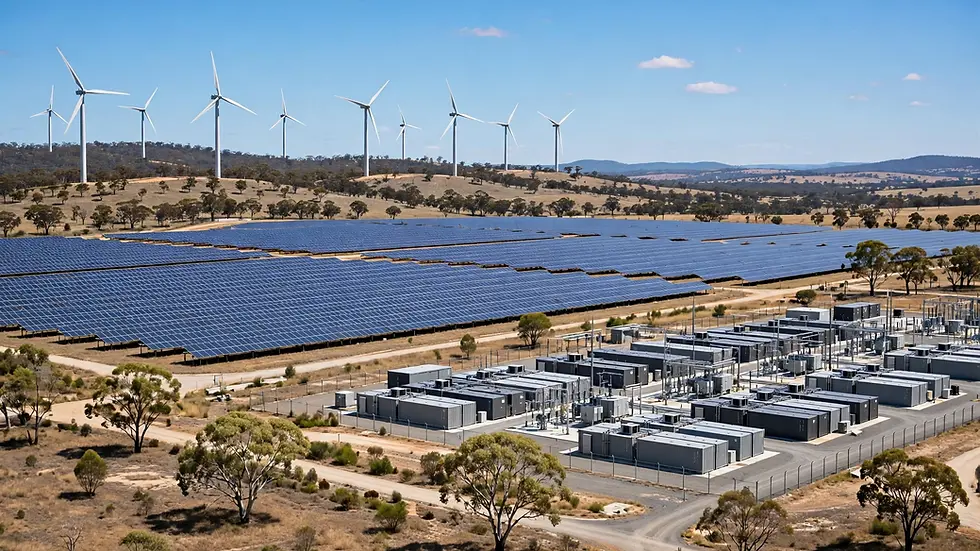
The deal. Neoen raised a new debt financing package of $1.8 billion (about US$1.2 billion) for a portfolio of five assets totalling approximately 1.2 GW. The lenders are ANZ, Bank of America, Bank of China, the Clean Energy Finance Corporation (CEFC), Export Development Canada, HSBC, ING, KfW IPEX, Mizuho, NAB, UOB, Société Générale and Westpac — a mix of Australian banks, international banks and Australia's government-owned green bank.
The assets. The portfolio mixes operating assets and assets under construction, across three states. No Queensland asset is in this particular portfolio — a point worth stating plainly, because Queensland readers should not assume a Queensland project was financed by this deal.
Asset | Technology and size | State | Status in the portfolio |
Hornsdale Power Reserve | Battery, 150 MW / 193.5 MWh | South Australia | Operating asset |
Goyder South Wind Farm Stage 1A | Wind, 209 MW | South Australia | In the portfolio mix |
Culcairn Solar Farm | Solar, 440 MWp | New South Wales | In the portfolio mix |
Culcairn Battery | Battery, 215 MW / 963 MWh | New South Wales | In the portfolio mix |
Narrogin Wind Farm | Wind, 179 MW | Western Australia | In the portfolio mix |
The scale in context. Including this financing, Neoen states it has raised more than $5 billion in debt financing for Australian projects since 2024, covering 4.7 GW across 20 wind, solar and storage assets. Neoen describes itself as Australia's largest renewable energy company, having contributed more than 6 GW of wind, solar and storage capacity, and states an aim of 10 GW of operational capacity in Australia by 2030. Those are Neoen's stated figures, reported by pv magazine Australia and the company's announcement, not independent verification by EServices4U.
Sources. pv magazine Australia, "Neoen Australia 1.8 billion debt finance raise backs a 1.2 GW portfolio", published 30 October 2026; Neoen's announcement, Paris and Sydney, 30 October 2026, as republished by trade outlets; ESS News, 30 October 2026, carrying the same pv magazine Australia report. All figures in this blog come from those sources.
2. Why it happened: portfolio financing, not project-by-project debt
A portfolio spreads risk for lenders. Financing five assets together — wind in two states, solar in a third, batteries in two states, at different stages — gives lenders diversification that a single project cannot. If one asset underperforms in a given period, the portfolio's other cash flows support the debt. That diversification is a large part of why a 13-lender syndicate will back a $1.8 billion package: the risk is pooled, and so is the due diligence.
It follows a pattern, not a one-off. Neoen has financed Australian assets in pooled portfolios before, including a portfolio financing in February 2024 and an expansion later that year, as noted in deal reporting. The 30 October deal is the largest in that sequence. The pattern matters because it shows lenders' appetite for Australian renewables is not a single transaction but a repeatable structure — at least for a developer with operating assets, contracted revenue and a track record lenders can diligence.
It sits against a stronger financing backdrop in 2026. The Clean Energy Council's large-scale generation and storage report for January to June 2026, reported in late October 2026, found more clean energy capacity reached financial close in the first half of 2026 than in all of 2025, with nine utility-scale batteries worth $4.3 billion and 2.3 GW / 7.1 GWh switched on in the period, and Queensland leading the nation in clean energy investment at $9.6 billion and 4.5 GW at financial close or under construction. The Neoen deal is consistent with that backdrop; it does not by itself prove that backdrop, and it should not be read as a guarantee that every project will find financing on similar terms.
What it does not prove. A portfolio refinancing and construction financing for an established developer is not the same as first-time project finance for a new developer, a merchant-exposed project with no contracted revenue, or a project facing connection delays. Readers should not take this deal as evidence that any particular project — in Queensland or elsewhere — will be financed, built on time, or delivered at any particular price. Lenders diligence each portfolio on its own contracts, connection position and construction risk.
3. What it changes
For the financed assets themselves. The package supports a mix of operating and under-construction assets, which means it both refinances existing capacity and funds completion of capacity still being built. For the Culcairn solar and battery pair in New South Wales and the Goyder South and Narrogin wind farms, financing of this kind is a precondition for construction proceeding on schedule — though the announcement does not, by itself, state a completion date for any individual asset, and this blog does not invent one.
For the broader market. A $1.8 billion, 13-lender portfolio deal signals that large-scale debt for Australian renewables remains available at scale for diversified, contracted portfolios, even in a period when other large projects have stalled seeking debt and equity — the subject of EServices4U's earlier single-news blog on Australia's biggest wind projects. The contrast is instructive: financing is available, but it is selective, and it favours portfolios and developers lenders already know.
For battery storage specifically. Two of the five assets are batteries — Hornsdale, the South Australian battery that has become the best-known grid battery in the country, and the 215 MW / 963 MWh Culcairn Battery, a long-duration asset at over four hours. The inclusion of long-duration storage in a portfolio financing, alongside wind and solar, reflects how batteries are now financed as part of a generation portfolio rather than as standalone merchant bets — a trend consistent with the longer-duration pipeline reported by AEMO in October 2026.
4. What this means for you
For investors and developers. Portfolio financing is a structure to study, not a template to copy blindly. Its advantages — diversification, a single diligence process, scale — depend on having multiple assets with contracted or credible revenue, and on a developer track record lenders trust. A single-asset developer, or a project with unresolved connection or offtake questions, will face a different conversation with lenders. Independent technical due diligence — connection position, construction risk, equipment and warranty, single-line diagrams and commissioning — is part of what makes a portfolio diligenceable in the first place.
For commercial and industrial buyers. Large portfolio financings do not change any individual buyer's electricity bill tomorrow. Their relevance is indirect and medium-term: financed wind, solar and storage capacity, once built and operating, adds supply to the market in its region, and contracted capacity can underpin corporate power purchase agreements. A Queensland commercial buyer should not expect a New South Wales, South Australian and Western Australian portfolio to lower a Brisbane bill directly — but should watch the Queensland pipeline, where Queensland led national clean energy investment in the first half of 2026, for the projects that will actually supply Queensland load.
For Queensland and Brisbane buyers. This deal contains no Queensland asset, so its direct Queensland implication is limited — and this blog does not invent one. The honest Queensland reading is threefold. First, Queensland's own investment momentum — $9.6 billion and 4.5 GW at financial close or under construction in the first half of 2026, per the Clean Energy Council report — is the figure Queensland buyers should watch, not a portfolio in other states. Second, the financing structure is relevant to Queensland developers seeking debt for their own portfolios, including the large Queensland solar and battery projects now moving through approvals and financing, such as the Upper Calliope, Bullyard and Tyrone projects in the Gladstone and Bundaberg regions, where 30-year agreements with Traditional Owners were reported in October 2026. Third, for a Brisbane homeowner or small business, the deal changes nothing about feed-in tariffs, network approvals or the case for a rooftop system — those remain premises-specific, through Energex in South East Queensland and Ergon Energy in regional Queensland.
For homeowners. No direct effect. Household solar and battery decisions still turn on daytime self-consumption, the retail import price, the low retailer-set feed-in value in South East Queensland, and the premises' network approval. A $1.8 billion utility-scale deal does not make a household system cheaper or more valuable by itself, and any quote that implies otherwise should be questioned.
5. What EServices4U would check independently
For a developer or investor considering a portfolio or project financing: technical due diligence on connection position, construction and commissioning risk, equipment and warranty, and single-line diagram review — through a Commercial Infrastructure Assessment / RPEQ & RPEV SLD Sign-Off from $495, with scope and qualifications confirmed before work starts.
For a commercial buyer assessing a power purchase agreement or a large rooftop proposal linked to a financed portfolio: a solar and battery feasibility assessment from $299, checking load, tariff, metering and the actual contract terms rather than the headline capacity.
For a homeowner or small business: a residential quote review from $149, or a feasibility assessment from $299, checking the specific premises, tariff and network approval.
Home Owner's Engineer services — from $599 — where that scope fits a particular engagement.
EServices4U does not sell installations and does not receive installer commissions, so the review is independent of the developer, the lenders and any tenderer.
Frequently asked questions
Is this $1.8 billion a grant or government funding?
No. It is debt financing from 13 lenders, including the government-owned Clean Energy Finance Corporation alongside commercial banks. Debt must be repaid from the portfolio's revenue; it is not a subsidy, and it does not make the electricity from these assets free.
Does this deal include any Queensland project?
No. The five assets are in South Australia, New South Wales and Western Australia. Queensland's investment story is separate, and is better tracked through Queensland projects and the Clean Energy Council's Queensland figures.
Does this mean renewable energy financing is easy again?
No. It means portfolio financing for an established developer with diversified, contracted assets attracted a large syndicate. Single projects, new developers and merchant-exposed projects face a different, harder conversation, as shown by other large projects stalling while seeking debt and equity.
Will this lower my electricity bill?
Not directly or immediately. Wholesale and retail prices depend on supply, demand, network costs, contracts and many other factors in each region. A financed portfolio helps supply over time; it does not set any household or business tariff.
What should a developer learn from this deal?
That lenders reward diversification, contracted revenue and a track record — and that technical diligence, connection certainty and construction readiness are part of the financing story, not an afterthought to it.
Get an independent check before you commit to a project or quote
Start with a free 15-minute consultation to talk through your tender, system, building, or project and find out which fixed-fee review fits, if any. Call/WhatsApp 0480 001 498 or email growthpartner@eservices4u.com.au. No obligation, and it does not include a written report.
Solar and battery feasibility assessment — from $299. See packages and pricing.
Commercial Infrastructure Assessment / RPEQ & RPEV SLD Sign-Off — from $495.
Home Owner's Engineer services — from $599.
Residential solar quote review — from $149.
Learn more about EServices4U, the Owner's Engineer service, the team, or request a quote.
Based in Queensland, serving Australia-wide. EServices4U provides independent engineering advice; it does not sell solar installations and does not receive installer commissions.


Comments