
Queensland Car Dealership Solar: Showrooms, Service Bays and EV Charging That Pays

A Queensland car dealership is not a normal commercial building. It is a showroom, a workshop, a parts warehouse, a car park and, increasingly, a charging station — all on one site, all running at the same time, and all expected to look polished while they do it.
That combination is exactly why solar, battery storage and EV charging deserve a proper engineering plan at a dealership, rather than a panel count copied from another building. Showroom lighting and air conditioning run through the Queensland heat. Service bays run hoists, compressors, wash bays and diagnostic equipment. And the stock itself now needs power: electric vehicles on the yard must be kept charged for test drives and delivery, demonstrators need topping up between drives, and customers increasingly expect to charge while they wait.
This guide is written for Queensland dealership owners, dealer principals, group operations managers and the property managers who look after their sites — in Brisbane and South East Queensland, and in regional Queensland towns served by Ergon Energy. It explains how a dealership's load actually behaves, what solar, battery and EV charging can realistically do on that load, what the connection and incentive rules require you to check, and what an independent review should test before you sign.
EServices4U does not sell solar installations and does not receive installer commissions. The advice here is independent: it is written to help you assess technical suitability, value, risks and compliance before committing to an expensive energy project. EServices4U is based in Queensland and serves clients Australia-wide.
Why a dealership is a different solar problem
Most commercial solar guides start with a simple idea: put panels on the roof, use the power during the day, export the rest. A dealership breaks that simple idea in several useful ways.
Daytime load is high and varied. Showroom lighting, air conditioning, office equipment, parts storage and workshop loads overlap through the business day. That is good for solar self-consumption, because much of the generation can be used on site — but only if the system size, orientation and export limit match the real load shape.
The workshop adds sharp peaks. A hoist lifting, a compressor starting, a wash bay running and a spray booth heating can each add a short, sharp load. Together, at the wrong moment, they can set a new monthly demand peak.
EV stock is a load you cannot switch off casually. A petrol car on the yard needs nothing until it is sold. An electric car on the yard needs to be charged, kept at a sensible state of charge, and ready for a test drive or a same-day delivery. That is a new, ongoing electrical load that did not exist in the dealership's historical bills.
Customer dwell time is short but visible. A customer waiting for a service may be on site for an hour or two. A customer browsing may be there for thirty minutes. Charging offered during that window is a service, not a fuel station — and the charger type, the number of bays and the way charging is managed all matter more than the headline kilowatt rating.
None of this means solar is a poor fit for a dealership. It means the fit has to be engineered around the dealership, not assumed from a generic commercial template.
The dealership load, hour by hour
Before any panel count or charger count makes sense, the dealership's load profile needs to be understood — how much power the site uses, and when. Two dealerships of the same floor area can have very different profiles.
Showroom and offices: Lighting, air conditioning, display screens, computers and customer amenities. In a Queensland summer this is a long, steady daytime load, with air conditioning doing much of the work.
Service bays: Hoists, compressors, tyre equipment, diagnostic rigs, wash bays and, in some workshops, spray booths. These loads are intermittent and spiky, and a compressor cycling on and off all day adds a different pattern from a steady office load.
EV stock and demonstrators: Charging for vehicles held on site, demonstrators rotated through test drives, and delivered vehicles prepared for handover. This load is growing, and it is the least predictable from historical bills — because last year's bills were written before the stock was electric.
Customer charging: Chargers offered to customers while they wait, browse or collect a vehicle. This load depends on how many bays you provide, what power they deliver, and how long customers actually stay.
A useful way to think about it is to split the load into three buckets: the steady daytime base load that solar can serve well, the spiky workshop load that needs demand management, and the flexible EV charging load that can be scheduled, staggered or buffered — but only if the charging system is designed to allow it.
Ask for interval data before you accept a system size. Half-hourly or fifteen-minute metering data, ideally for a full year, shows when the peaks happen, how long they last, and whether solar generation lines up with them. A single annual kilowatt-hour total cannot answer those questions.
What solar can do on a dealership roof
A dealership usually has a large, flat or low-pitch roof over the showroom and workshop, and often a separate parts building. That roof area is the most obvious place for solar, and in Queensland it is a strong resource. But roof area alone does not set the system size.
Match generation to daytime use. The best financial case for commercial solar usually comes from using as much generation on site as possible, rather than exporting it. That means sizing to the daytime load, not to the roof.
Check the roof properly. Age, condition, membrane type, penetrations, skylights, air conditioning plant and access all affect where panels can go and how they are fixed. A roof that needs replacement in five years is not the right place for a twenty-five-year array without a plan for removal and reinstatement.
Consider orientation and tilt. North-facing panels suit a daytime load that peaks around midday. A split east-west layout can spread generation across the morning and afternoon, which can suit a dealership that opens early and closes late. The right answer depends on the load shape, not on a rule of thumb.
Allow for shading and soiling. Rooftop plant, parapets, signage and neighbouring buildings can shade parts of an array. Dust, leaves and bird fouling affect output too. A design that ignores shading will overstate generation.
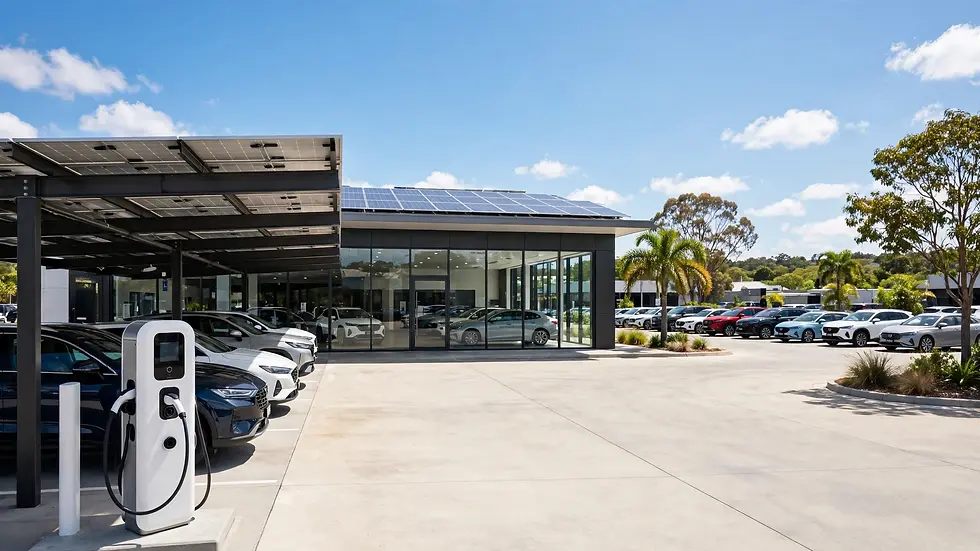
Solar carports deserve a separate look, because they solve two dealership problems at once: they generate power and they shade stock. A carport over new-vehicle holding, demonstrator parking or customer parking keeps vehicles cooler, protects paint and interiors from harsh Queensland sun, and gives the site a visible sustainability statement. They cost more per kilowatt than a rooftop array, because of the steel structure, footings and drainage, so the business case needs to include the shade and presentation value — not just the kilowatt-hours.
What the published Queensland examples actually show
Two published Queensland dealership examples are worth reading carefully — not as promises, but as illustrations of how different sites have approached the same problem.
The first is BYD Burleigh Heads on the Gold Coast. An installer-published case study (Solar Set) describes a 39.9 kW solar system with a 60 kWh battery — two Sungrow SBH 30 kWh batteries, a 25 kW hybrid inverter and 76 Trina 510W panels — built mainly to support service and EV charging. The point worth noting is the intent: the system was not sized as a generic rooftop array. It was built around the service and charging load, with battery storage to support it. As an installer-published case study, it describes what was installed and why; it is not an independent performance audit, and it should not be read as a guarantee that the same configuration would suit a different dealership.
The second is Llewellyn Motors in Ipswich. A published example from 2017 (an industry article, updated 2 November 2026) describes a 1,232-panel, 332 kW system that provides around half the business's electricity needs, with about $7,000 saved on power bills since switch-on in October of that year. That is a 2017 published example, not a current promise. Panel prices, tariffs, network rules and the dealership's own load have all changed since then.
Read together, the two examples make a useful point. A small-to-mid-size dealership supporting service and EV charging might be looking at a system in the tens of kilowatts with battery storage. A large multi-franchise site with a big roof and a big workshop might be looking at several hundred kilowatts. The right size is set by the load, the roof, the connection approval and the business case — not by either example.
EV charging at a dealership: three different jobs
One of the most common mistakes in dealership charging design is treating all charging as the same job. It is not. A dealership typically needs charging for three different purposes, and each one wants a different charger type, a different location and a different management rule.
Stock and demonstrator charging: Vehicles held on site need to be kept at a sensible charge level and ready for test drives and delivery. This is usually best served by a number of lower-power AC chargers in the holding and preparation areas, managed so that vehicles are charged overnight or during low-load periods, and topped up during the day as needed. The goal is readiness, not speed.
Service and handover charging: A vehicle that has been serviced, or a new vehicle being prepared for delivery, may need a faster top-up before the customer arrives. This is where a smaller number of higher-power chargers, close to the service reception and delivery bay, can make sense.
Customer charging: Chargers offered to customers while they wait or browse. Here the dwell time sets the value. A customer waiting an hour for a service gains useful range from a Level 2 AC charger. A customer browsing for thirty minutes gains very little from the same charger, and a DC fast charger may be oversized for that visit. The charger needs to match the visit, not just the vehicle.
Australian Government guidance gives a useful sense of scale: Level 2 charging provides roughly 30–130 km of range per hour depending on the equipment and the vehicle, while Level 3 (DC) charging typically operates at 25–350 kW. Those are wide ranges, and they are wide for a reason — the actual rate depends on the charger, the vehicle, the battery state of charge and the temperature. A design that assumes the top of the range for every vehicle will overstate what customers actually receive.
The same guidance carries a design instruction that matters more than the headline rates: assess historical peak loads and energy-use patterns before designing multi-charger infrastructure, and use load management to limit the impact of EV charging on building peak demand. In plain terms, do not add chargers without first understanding the peaks they will land on — and do not assume they can all run at full power at the same time.
Demand charges: where fast charging can hurt
For many Queensland commercial sites, the electricity bill is not just about how many kilowatt-hours are used. It is also about demand — the highest rate at which power is drawn, usually measured over a short interval, and charged as a demand or capacity charge.
That matters for EV charging because a fast charger can create a new demand peak in minutes. A site that has run comfortably for years with a peak set by the workshop and air conditioning can set a much higher peak the first week a DC fast charger runs at full power alongside a busy service bay. That higher peak can then be charged for the rest of the billing period, even if the charger is only used occasionally. There are four levers that reduce that risk, and a good design will use more than one of them.
Load management: A charging management system that watches the site's total load and throttles chargers when the workshop or air conditioning peaks, then releases them when load falls. This is the single most important control for a dealership with multiple chargers.
Staggered charging: Stock vehicles do not all need to charge at once. A managed queue that charges vehicles in sequence, or at reduced power overnight, can deliver the same total energy with a much lower peak.
Battery buffering: A battery can discharge during a charging peak and recharge when the site load is lower. This is the role the Burleigh Heads example points to — the battery supporting service and EV charging, not just storing solar for the evening.
Tariff choice: The right tariff for a site with EV charging is not necessarily the one it had before charging was added. Review it when chargers are added, and confirm the site's own tariff in writing.
A designer who proposes multiple DC fast chargers without a load management plan, a demand assessment and a tariff review has not finished the design. Ask for those three things in writing before you approve the charger count.
Battery storage: what it is for at a dealership
A battery at a dealership can do several jobs, but it cannot do all of them at full strength at the same time. The design needs to name the primary job and size the battery for it.
Peak shaving: Discharging during short demand peaks — a fast-charging session, a workshop peak, a hot afternoon — to keep the site's maximum demand down. This needs power (kilowatts) more than it needs long duration.
Solar shifting: Storing midday solar generation for use in the late afternoon or evening, when the showroom is still open but the sun is lower. This needs energy capacity (kilowatt-hours) and a charge-discharge pattern that matches the load.
Charging support: Providing power to EV chargers when the grid connection or the site's demand limit would otherwise constrain them. This is a combination of power and energy, and it needs a control system that can respond quickly.
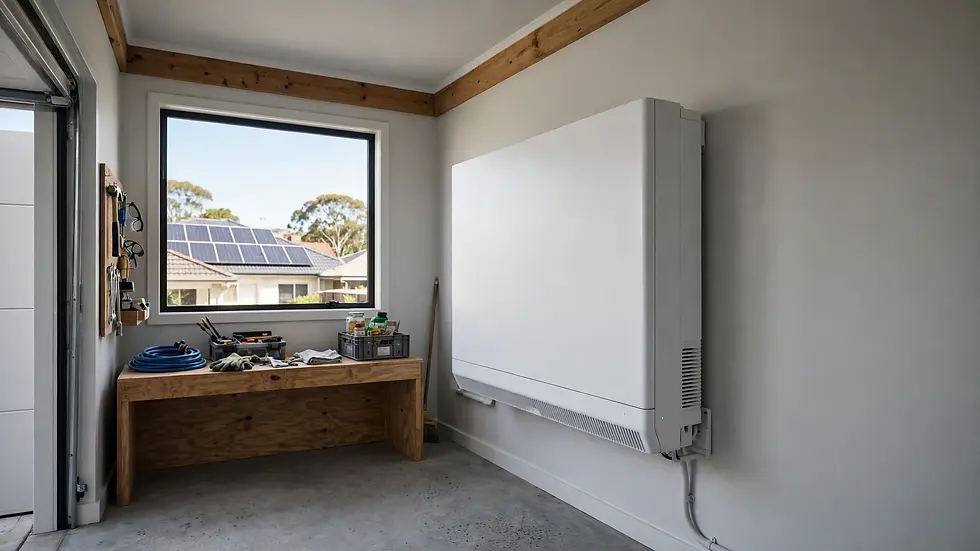
Resilience: Keeping critical loads running during an outage — service reception, security, communications, or a single charger. A battery can support this only if it is designed with backup capability, islanding protection and a defined list of backed-up circuits. A standard grid-connected battery does not automatically provide backup power.
The 60 kWh battery in the Burleigh Heads installer-published example is a useful scale reference for a single-site service and charging application — not a recommendation. A larger site with more chargers, a bigger workshop peak or a longer evening load will need a different size, and the only way to set it is to model the load, the solar generation and the charging pattern together. Battery safety and placement also matter: location, ventilation, clearances, fire separation where required, and access for maintenance and emergency services should be answered on the drawings.
Connection and export: confirm before you build
In Queensland, connecting solar, battery and EV charging to the grid is not a formality. The network that serves the site — Energex in South East Queensland, Ergon Energy in regional Queensland — needs to approve the connection, and the approval sets limits on system size, export and, in some cases, how the system must behave.
Queensland connection and export rules are published as network-guide summaries. The practical instruction is simple: confirm your connection approval in writing before you commit to a system size, an export arrangement or a charger count. Do not rely on a verbal assurance, a neighbouring site's approval, or a proposal that assumes export will be approved at the full system size.
The questions to have answered in the approval, or in the application, include:
What size system is approved, and at what export limit? A system may be approved to generate more than it is allowed to export. The difference matters for the business case.
Is export limited, zero export, or flexible? Each arrangement changes how much generation is used on site, how much is stored, and how much is curtailed. A design that assumes full export will overstate returns if the approval is export-limited.
Does the battery change the connection? A battery that can export, or that can charge from the grid, may need to be included in the connection application. A battery added later without an updated approval can create a compliance problem.
Do the EV chargers need a separate assessment? Multiple chargers, particularly DC fast chargers, add load that the existing connection may not have been sized for. The network may require an upgrade, a load management commitment, or a staged connection.
What protection and control settings are required? Inverter settings, export limiting, volt-watt and volt-var responses, and grid support settings are set by the network's requirements and the applicable standards. These are not installer preferences.
A related update for sites adding EV chargers: a Queensland EV charger update from 1 October 2026 allows single-phase 32A charging without a network management device, with the earlier 20A restriction removed. Confirm the current rule for the site's network and connection type before relying on it.
If a proposal does not mention the connection application, the export limit or the network by name, treat that as a gap, not as a detail to be sorted out later. The connection approval is part of the project, not an afterthought.
Incentives and timing: what changed in late 2026
Several incentive and scheme changes in late 2026 affect the timing and the paperwork for a dealership project. They do not change the engineering, but they do change what to check and when.
Mid-scale solar STCs are now open. The Clean Energy Regulator has confirmed that STC applications for mid-scale solar — systems from 100 kW to 1 MW, installed from 1 October 2026 — opened in the REC Registry on 17 November 2026, with fixed 5-year deeming. For a dealership considering a system in that size range, this is a material change: a system that was previously outside the small-scale scheme may now be eligible, subject to the scheme rules. Confirm eligibility, the installation date, and the deeming arrangement in writing — do not assume a system qualifies because it falls in the size range.
Deeming and battery factors change on 1 January 2027. Published guide figures state that solar deeming falls from 5 to 4 years and the battery STC factor falls from 6.8 to 5.7 on 1 January 2027, and that the discount is set by the installation date — check your quote. The practical point is about timing: the incentive value depends on when the system is installed, not when the proposal was written. If a proposal quotes an incentive figure, ask which installation date it assumes and what happens if the installation slips past a scheme change.
The DRIVEN charger grant is closed. The federal DRIVEN Program included a $20 million Charger Grant Stream for new public fast chargers at eligible automotive dealerships, service centres and EV repair facilities. The registration period closed on 28 August 2026. That stream is closed — do not present it as open or available, and do not let a proposal imply that a grant will offset the charger cost unless it names a different, currently open program and confirms the site's eligibility for it. If another grant or rebate is proposed, ask for the program name, the closing date, the eligibility criteria and the amount, in writing.
Quality checks matter more than ever. The Clean Energy Regulator's 2025–26 SRES inspection report, published 16 November 2026, found that 61.19% of inspected battery systems and 23.11% of inspected solar systems were rated substandard. That is a finding about the systems inspected under that program — not a claim about any specific installer, brand or dealership. What it does support is a quality argument: inspections, documentation, commissioning tests and an independent review are how you find out whether the system on your roof matches the system on the proposal.
None of these points is a reason to rush a project to meet a deadline. A rushed installation that misses a connection approval, a protection setting or a commissioning test can cost more than the incentive it was trying to capture.
Choosing chargers: AC, DC and the mix that fits
The charger mix is one of the most consequential decisions in a dealership project, because chargers are expensive, they last for years, and they are hard to move once the civil and electrical work is done.
Charger type | Typical use at a dealership | What to check |
AC Level 2, lower power | Stock holding, demonstrator rotation, overnight charging, staff parking | Number of bays, load management, cable length, weather protection, access control |
AC Level 2, higher power | Service reception top-ups, delivery preparation, customer waiting areas | Dwell time, vehicle compatibility, demand impact, tariff effect |
DC fast charging (Level 3) | Fast top-up before delivery, public-facing charging if offered, high-turnover bays | Grid capacity, demand charges, load management, civil works, ongoing maintenance |
Managed / smart charging | Whole-site coordination of all chargers | Control system, site load limit, priority rules, reporting, remote monitoring |
Charging job | Best charger type | Key design question |
Keep stock ready for test drives | Multiple AC chargers, managed | How many vehicles need to be ready each morning, and at what charge level? |
Top up a vehicle before delivery | One or two higher-power chargers near delivery | How much range is needed, and how much time is available? |
Charge while a customer waits | AC chargers matched to dwell time | How long does the customer actually stay? |
Offer public fast charging | DC fast charger, if the business case supports it | Is the site suited to public access, payment, signage and 24-hour use? |
Charge the demo fleet overnight | Managed AC charging, scheduled | Can charging be shifted to low-load hours without affecting readiness? |
A few practical points cut across all charger types. Do not oversize for the visit, plan conduit and switchboard capacity for more chargers later, decide access control and payment early, and remember maintenance is a running cost.
The business case: what to count, and what not to assume
A dealership solar, battery and EV charging business case has more moving parts than a simple rooftop solar case. The parts that are often missed are the ones that change the answer.
Count these:
Avoided energy costs from solar used on site, based on the site's actual retail tariff and the actual self-consumption — not on an assumed export price.
Demand charge effects, positive and negative. A battery and load management can reduce demand charges. Unmanaged fast charging can increase them. Both effects need to be modelled.
Incentives that are confirmed, with the installation date and eligibility checked. An STC value that depends on a future installation date is not yet a confirmed value.
Connection and upgrade costs, including any network augmentation, switchboard upgrade or transformer work required by the connection approval.
Do not assume these:
Guaranteed savings or a guaranteed payback period. Savings depend on future tariffs, future load, future export arrangements and future weather. A proposal that guarantees savings has not allowed for those variables.
That export will always be available at the same price. Export limits, export tariffs and network rules change. A business case that depends on high export revenue is more exposed than one that depends on on-site use.
That the load will stay the same. A dealership that adds EV stock, expands the workshop or adds a new franchise will use more power. A system sized for today's load may be undersized for tomorrow's — or it may be the right first stage in a staged plan. Either way, say so explicitly.
An independent feasibility review that checks the load data, the generation model, the tariff, the connection approval and the proposal's arithmetic — before you sign — is cheaper than a system that does not perform as promised.
What to ask any installer or designer — before you sign
A good proposal answers questions before you have to ask them. If a proposal does not, ask the questions below and get the answers in writing. The answers matter more than the brochure.
Load and generation model: What interval data was used? What is the assumed daytime load, the assumed self-consumption, and the assumed export? What happens to the business case if self-consumption is ten percent lower than assumed?
System size and layout: Why this size, and why this layout? What roof areas were excluded, and why? What shading was allowed for?
Connection approval: Has the connection application been lodged? What export limit has been requested? What happens if the network approves a lower limit?
Battery purpose and sizing: What is the battery's primary job — peak shaving, solar shifting, charging support or backup? What power and energy ratings support that job?
Charger management: How does the load management system work? What is the site load limit? What happens when the workshop peaks while chargers are running? Can the priority rules be changed later?
The Clean Energy Regulator's inspection findings, published 16 November 2026 — 61.19% of inspected battery systems and 23.11% of inspected solar systems rated substandard — are a useful backdrop here. The difference between a good installation and a poor one is the design, the installation quality, the commissioning and the documentation. Ask for evidence of all four.
A staged plan that dealerships can actually follow
Most dealerships do not need to do everything at once. A staged plan, with each stage designed so the next stage does not require rework, is often the most practical way to proceed.
Stage 1 — Understand and prepare: Gather twelve months of interval metering data. Record the EV stock charging load separately. Confirm the connection capacity, the current export arrangement and the tariff. Commission an independent feasibility review before any installer proposal is accepted.
Stage 2 — Solar and load management: Install rooftop solar sized to the daytime load and the approved export limit, along with the load management and monitoring system that will later control the chargers — cheaper to install now than to retrofit later. Commission, test and document the system, and review the first few months of performance against the model.
Stage 3 — Battery and charging: Add the battery, sized for the primary job identified in Stage 1. Install the first chargers, with conduit and switchboard capacity for more. Review the tariff and demand charges after a few months of charging data, and adjust the load management settings if needed.
Stage 4 — Expand and refine: Add carport solar, additional chargers or additional battery capacity as the EV stock grows and the data shows what is actually needed. Review the system annually against the load, the tariff and the network rules. A system that is reviewed stays useful; a system that is installed and forgotten slowly drifts away from its business case.
A staged plan also helps with timing. If an incentive depends on an installation date — as the published guide figures for the 1 January 2027 deeming and battery factor changes suggest — a staged plan lets you decide deliberately which stage to bring forward and which to leave until the design is right, rather than rushing the whole project to meet a single date. Regional Queensland deserves a note here too: a dealership in Cairns, Townsville, Mackay, Rockhampton or Toowoomba faces the same load and charging questions as a Brisbane dealership, but the network is Ergon Energy, not Energex — so confirm the Ergon Energy connection requirements for the specific site, use local solar and weather data, and note that regional customers driving longer distances may value a fast top-up more.
How This Works for Both Sides
A dealership energy project works best when it works for both the dealership and the people who design, install and review it.
For the dealership: A system sized to the real load, with managed charging and a confirmed connection, gives lower energy costs without new demand peaks. A battery sized for a named job does that job well. Chargers that match dwell time and readiness needs give customers a useful service and staff a practical tool. A staged plan lets the dealership invest as the EV stock grows. And an independent review before signing gives the dealer principal confidence that the proposal has been tested against the site's own data, not just against a sales target.
For the installer, designer and reviewer: A clear brief — load data, roof information, charger needs, staging intentions — lets the designer produce a design that fits, rather than a generic proposal that has to be reworked. A confirmed connection approval and a named export limit let the installer order the right equipment and set the right protection settings the first time. A commissioning and handover plan, agreed before installation, means the system is tested, documented and handed over properly. A monitoring arrangement after installation gives both sides a shared record of how the system actually performs, so any issue is found early and fixed while it is still small.
When both sides have the same information — the load, the connection, the tariff, the staging plan and the commissioning standard — the project is simpler, the risks are lower, and the system is more likely to do what it was bought to do.
Frequently asked questions
How much solar does a Queensland car dealership need?
There is no standard size. A small dealership supporting service and EV charging might need a system in the tens of kilowatts with battery storage, as the Burleigh Heads installer-published example illustrates.
Should a dealership install DC fast chargers or AC chargers?
Usually both, in different places for different jobs. Multiple AC chargers suit stock holding, demonstrator rotation and overnight charging.
Will EV charging increase our demand charges?
It can, if the chargers run unmanaged at full power during a workshop or air conditioning peak. Load management, staggered charging, battery buffering and tariff choice can limit that effect.
Is the federal DRIVEN charger grant still available for dealerships?
No. The DRIVEN Program's $20 million Charger Grant Stream for new public fast chargers at eligible automotive dealerships, service centres and EV repair facilities closed its registration period on 28 August 2026.
What is the mid-scale solar STC change, and does it affect a dealership?
The Clean Energy Regulator has confirmed that STC applications for mid-scale solar — systems from 100 kW to 1 MW, installed from 1 October 2026 — opened in the REC Registry on 17 November 2026, with fixed 5-year deeming. If a dealership is considering a system in that size range, confirm eligibility, the installation date and the deeming arrangement in writing.
Do we need battery storage, or is solar alone enough?
Solar alone can be the right first stage for a dealership with a strong daytime load and a confirmed export arrangement. A battery adds value when there is a specific job for it — shaving demand peaks, shifting solar to the late afternoon, supporting EV charging, or providing backup for defined critical loads.
What should we check about our grid connection before we build?
Confirm, in writing, the approved system size, the export limit, whether the arrangement is export-limited, zero export or flexible, whether the battery and the chargers are included in the approval, and what protection and control settings are required. Energex serves South East Queensland and Ergon Energy serves regional Queensland.
Can EServices4U review our dealership solar, battery and EV charging proposal?
Yes. EServices4U provides independent reviews of commercial solar, battery and EV charging proposals, feasibility assessments and infrastructure designs — including the connection, load, tariff and staging questions in this guide.
For more on how EServices4U approaches independent commercial reviews, see the EServices4U home page, the packages and pricing page, the Owner's Engineer service, the team page, and the quote page.
Get an independent review before you sign
Start with a free 15-minute consultation to talk through your tender, system, building, or project and find out which fixed-fee review fits, if any. Call/WhatsApp 0480 001 498 or email growthpartner@eservices4u.com.au. No obligation, and it does not include a written report.
Residential solar quote review — from $149: an independent check of a home solar or battery quote, so you can see what is sound, what is overstated, and what to ask before you commit.
Solar and battery feasibility assessment — from $299: a review of whether solar and battery storage suit your site, your load and your roof, and what size and arrangement make sense.
Home Owner's Engineer — from $599: independent engineering support through a residential solar or battery project, from design review to commissioning checks.
Commercial Infrastructure Assessment / RPEQ & RPEV SLD Sign-Off — from $495: independent review of commercial solar, battery and EV charging infrastructure, including single-line diagram review and RPEQ and RPEV sign-off where required.
Contact EServices4U on 0480 001 498 or at growthpartner@eservices4u.com.au, or visit https://www.eservices4u.com.au/ — based in Queensland, serving Australia-wide.


Comments