
Queensland Flood-Prone Homes: Solar, Battery & Blackout Resilience

If your home sits in a flood overlay or a low-lying part of Brisbane, Ipswich, Gympie or regional Queensland, solar and battery decisions are different from the standard rooftop quote. The panels on the roof are only half the story. The parts that usually fail in a flood — the inverter, the battery, the switchboard, the isolators and the wiring — sit at ground level, exactly where the water goes.
This guide explains how to design solar and battery so it stands the best chance of surviving flooding, what to elevate and what not to assume, and how to plan blackout backup during storms. It is written for homeowners, not installers, and it is deliberately blunt about the limits: no residential solar system can be guaranteed flood-proof. What you can do is reduce the risk, protect the expensive equipment, and avoid the mistakes that turn a flooded inverter into a safety hazard.
EServices4U is based in Queensland and serves clients Australia-wide. This guide uses Queensland examples because that is where most of the flood-risk questions we see come from, and because Brisbane's flood history makes the stakes very real. The principles apply anywhere in Australia where a home sits in a flood overlay.
Why flood-prone homes need a different solar design
A standard solar quote assumes the inverter and battery go in the most convenient spot — usually the garage wall, a side wall at ground level, or a sheltered outdoor area near the meter box. On a flat block with no flood history, that is fine. On a flood-prone property, it can mean the most expensive parts of the system are the first things the water reaches.
Flood damage to solar equipment is not just about the replacement cost. Water entering inverters, batteries and junction boxes can cause immediate and irreversible damage. A flooded battery must not be assumed safe or functional, even if it looks intact from the outside. And wet appliances, wiring and switchboards are a serious electric shock risk — this is not a problem you solve by drying things out and switching the system back on.
The other point homeowners miss is that a battery is not a flood guarantee. A battery designed for ordinary grid-outage backup is designed for a different problem: the grid goes down, the battery keeps the fridge and lights running. A flood is a different problem again, because the water may reach the battery itself. If the battery is under water, its backup function is irrelevant — it is a safety risk, not a power source.
Getting this right starts before you accept any quote. The design questions are: what is your property's assessed flood level, what equipment will sit above it, what will be shut down and how, and what happens after the water recedes. If a quote does not answer those questions, it is not a quote for a flood-prone home.
Start with your property's flood level, not a product
Before you compare panels or batteries, find out what flood risk applies to your specific property. Brisbane City Council, Ipswich City Council and other Queensland councils publish flood overlay maps and property flood reports, and your property may sit in an overlay even if it has never flooded in your time there. A flood overlay is a planning and risk tool, not a prediction that water will reach your floor — but it is the starting point for every design decision that follows.
Check the flood overlay and flood level: Ask your council for the flood information that applies to your address, including the defined flood level or the level used for planning in your area. This is the number everything else is measured against.
Check whether the home has flooded before: Ask the previous owner, neighbours, and your insurer. A home that flooded in 2011 or 2022, or in a more recent event, carries a known risk profile that a generic quote will not reflect.
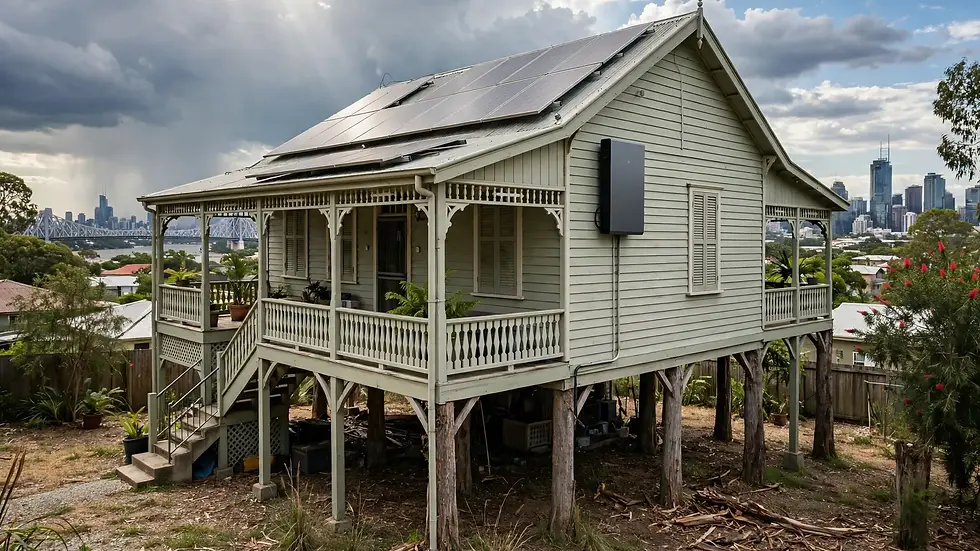
Check the home's construction: Low-set 1960s and 1970s homes are a particular focus of Brisbane's retrofit push, because their switchboards, power points and wiring were often installed at heights that now sit below expected flood levels. A Queenslander on stumps has more options for elevation than a slab-on-ground home, and that changes the design.
Check your insurance position: Tell your insurer what you are planning before you install, not after. Some insurers ask about solar and battery installations, and a flood-prone property may have specific conditions. Verify the details with your insurer directly — do not rely on an installer to answer insurance questions.
Get an independent review before you sign: A fixed-fee review of the quote and the proposed equipment locations can catch a ground-level battery on a flood-prone block before it is bolted to the wall. That is a far cheaper problem to fix on paper than after installation.
What Brisbane City Council's Flood Resilient Homes program tells us
Brisbane City Council runs a Flood Resilient Homes program that offers professional property assessments and tailored recommendations for homes in flood-affected areas. The program's retrofit push in early 2026 focused in particular on low-set 1960s and 1970s homes, and the common upgrades it recommends are directly relevant to solar and battery design.
It is reported that the program's recommended upgrades include relocating switchboards, power points and wiring above expected flood levels, and raising air-conditioning compressors, water heaters and solar battery systems onto elevated platforms or upper walls. That is the same logic this guide follows: the electrical heart of the home goes up, not down.
The program is a useful reality check for any solar quote on a flood-prone Brisbane home. If the proposed battery location is below the level the Council's own guidance would treat as flood-safe for a water heater or an air-conditioning compressor, ask why the battery is different. The answer may be a good one — there may be a structural or electrical reason — but it should be a specific answer about your property, not a general assurance that the battery is "weatherproof". Weatherproof and flood-proof are not the same thing.
The Queensland Government's Resilient Homes Fund also provides state-supported funding to retrofit homes, raise structures, or relocate essential services. Funding criteria and amounts change, so verify the current eligibility rules and application process with the Queensland Government before assuming you qualify. Do not let any installer quote a grant amount or a funding outcome on your behalf.
What to elevate — and what cannot be elevated
Elevation is the single most effective thing you can do for flood resilience, and it is also the simplest to check on a quote. The rule is straightforward: every piece of electrical equipment that can be put above the assessed flood level should be, where permitted, and everything that cannot be elevated needs a shutdown and inspection plan instead.
Equipment | Elevate above flood level? | What to ask |
Solar inverter | Yes, where permitted | Can it be mounted on an upper wall or elevated platform, with cabling routed to suit? |
Battery unit | Yes, where permitted | Is the proposed location above the assessed flood level, and is the wall or platform rated for the battery's weight? |
Battery isolators and disconnects | Yes | Are isolators at the same elevated height as the battery, and reachable safely? |
Main switchboard | Yes | Can the switchboard be relocated above the flood level, as the Flood Resilient Homes program recommends? |
Power points and wiring | Yes, where practical | Which circuits can be raised, and which ground-level circuits need flood-rated treatment or shutdown? |
Air-conditioning compressor | Yes | Can it be raised onto an elevated platform or upper wall? |
Hot water system | Yes | Can it be raised, and does that affect its plumbing and electrical connections? |
Solar panels (roof) | Already elevated | Panels sit on the roof, so they are not usually the flood risk — the inverter and cabling are. |
Meter box | Often fixed — ask | If the meter box cannot move, what is the shutdown and inspection plan for it? |
Underground cabling | Cannot elevate | Is any cabling in a flood path, and what protection or shutdown applies? |
A few cautions belong with this table. First, elevation must be done where permitted — building, electrical and planning rules may limit where equipment can go, and a battery mounted high on a wall still needs proper structural support, ventilation and safe access for servicing. Second, elevating the battery does not make the system flood-proof. It reduces the chance that water reaches the equipment. If water reaches the assessed flood level plus a margin, or if the flood exceeds the level the design allowed for, the same shutdown and inspection rules apply. Third, elevation is not a substitute for a proper shutdown plan. Even elevated equipment may need to be shut down if flood water threatens cables or the wider network.
Solar panels keep producing power — even when the mains is off
This is the safety fact most homeowners do not know, and it matters most during a flood. Energex's severe-weather safety guidance is clear: solar panels keep producing electricity even when mains power is disconnected. Turning off the power at the switchboard does not stop the panels from generating. The array is live whenever there is sunlight on it.
That has direct consequences for a flood-prone home:
Do not assume a blackout makes the system safe: If the grid goes down in a storm, the panels are still generating. Do not touch, move or attempt to disconnect solar components yourself.
If flood water may reach inverters and cables, ask a licensed electrical contractor or accredited installer to fully shut down the solar PV array: This is Energex's guidance, and it is a job for a qualified person, not a homeowner with a ladder.
Do not turn off a solar system if components are wet: Energex advises against switching off a system when its components are wet. If water has reached the equipment, stay away from it and call a licensed electrical contractor.
After flooding, do not reconnect a submerged system until it has been inspected by a qualified technician: This applies even if the system looks undamaged. Water inside an inverter or battery is not always visible from the outside.
Energex may disconnect power if another part of the network is flooded: Your home's power may be cut even if your own property is dry, because the network upstream is affected. That is a network safety decision, not a fault in your system.
Modern systems have fault and overvoltage protection and automatic shutdown features, and those help. But automatic shutdown is not a substitute for a planned shutdown by a qualified person, and a flooded battery must not be assumed safe or functional because it shut itself down. The GSES extreme-weather guidance makes the same point: turning off the system is recommended for batteries that may be submerged, and water entering inverters, batteries and junction boxes can cause immediate and irreversible damage.
Planning blackout backup for a flood-prone home
A battery's most useful job during a storm is keeping essential loads running through a blackout: the fridge, some lights, phone charging, a medical device if one is in the home, and perhaps a fan. On a flood-prone property, the backup plan needs one extra layer: the battery itself must survive the event it is meant to carry you through.
Start by separating essential loads from everything else. A battery sized for "the whole house" during a blackout is a very different — and much more expensive — proposition from a battery sized for a defined set of essentials for a defined number of hours. Most flood-prone homeowners are better served by a smaller, well-planned backup than by a large battery that promises everything and delivers it only if the grid outage is short and the weather is mild.
Essential load | Typical power draw | Why it matters in a storm |
Fridge and freezer | 100–200 W running, higher on start-up | Food safety during a multi-hour or multi-day outage |
LED lights (a few rooms) | 5–15 W each | Safe movement around the home at night |
Phone and device charging | 5–20 W each | Communication, weather updates, emergency information |
Internet router | 10–20 W | Access to warnings, Energex outage information and emergency updates |
Medical device | Verify the device's rating | Some devices are life-critical — verify the exact power need and runtime with the manufacturer |
Fan (one or two) | 30–75 W each | Comfort and sleep during a humid Queensland storm outage |
Sump or drainage pump | Verify the pump's rating | Only if your property relies on a pump — check whether it is on the backup circuit |
The table above uses typical figures only. Verify the actual power draw of your own appliances before sizing anything, and verify the battery's usable capacity, continuous output and backup-circuit design with the installer and the product datasheet. A battery's headline capacity in kilowatt-hours is not the same as the power it can deliver continuously, and not every battery can back up every circuit in the home.
Also ask these questions before you buy:
Which circuits are on backup, and which are not? Get the list in writing. If the air-conditioning, hot water and oven are not on backup, that is normal — but you should know it before the blackout, not during it.
How long will the essentials run? Ask for a runtime estimate based on your actual loads, not a generic claim. A battery that runs the fridge for eight hours is a different proposition from one that runs it for two days.
What happens when the battery runs flat during an outage? Can the solar panels recharge it the next day while the grid is still down? Not every system can do this, and it depends on the inverter and battery design.
Is the backup circuit above the flood level? A backup circuit that runs through a flooded switchboard is no use. Check that the backup wiring and the circuits it serves are part of the elevation plan.
Who do you call if the system faults during a storm? Have the installer's emergency number and Energex's fault number saved before the storm season, not after.
What not to assume
Flood-prone solar design is full of plausible-sounding assumptions that do not hold up. These are the ones we see most often:
"The battery is weatherproof, so it is flood-proof." It is not. Weatherproof ratings cover rain and splashing, not submersion. No residential solar system can be guaranteed flood-proof.
"The panels are on the roof, so the system is safe." The panels are the least flood-exposed part. The inverter, battery, isolators and cabling are the risk.
"The system will shut itself down." Modern systems do have automatic shutdown and fault protection, and that helps. It does not make a flooded battery safe, and it does not remove the need for inspection by a qualified technician before reconnection.
"I can just switch it off myself if water comes in." Energex advises against turning off a solar system if components are wet. Shut down the array through a licensed electrical contractor or accredited installer, and stay clear of wet electrical equipment.
"The battery will keep the house running through the flood." A battery is for grid-outage backup. If flood water reaches the battery, the battery is a safety risk, not a power source. Plan your blackout backup around the battery staying dry.
"My flood risk is low because it has never flooded here." Flood overlays, council flood levels and the 2011 and 2022 events tell a different story for many Brisbane and Queensland suburbs. Check the overlay for your address rather than relying on memory.
"The grant will cover it." Funding such as the Queensland Resilient Homes Fund has eligibility rules and limits. Verify the current rules with the Queensland Government before budgeting on that basis.
Dated updates that affect flood-prone buyers
Several recent changes affect what a flood-prone homeowner in Queensland should expect from a solar and battery quote. These are dated, sourced updates, not general claims, and they are included here because they change the numbers or the rules behind a quote you may receive now.
Federal Cheaper Home Batteries Program, from 1 July 2025: The federal battery rebate has been available since 1 July 2025. It supports household battery installations, and the amount depends on the battery's usable capacity. Verify the current eligibility rules and the amount that applies to your system with the Clean Energy Regulator before relying on it in a quote.
Battery STC factor change, 1 January 2027: The battery small-scale technology certificate factor falls from 6.8 to 5.7 on 1 January 2027, and the solar deeming period falls from 5 years to 4 years. That changes the certificate value of a system installed after that date, so the timing of an installation can affect the financial outcome. Verify the current deeming and factor figures with the Clean Energy Regulator at the time you are quoted.
Clean Energy Regulator SRES expansion, 1 October 2026: The Small-scale Renewable Energy Scheme expanded to mid-scale systems from 100 kW to 1 MW from 1 October 2026, with applications expected in mid to late November 2026. This matters mainly for larger commercial systems, but it is relevant if your property includes a larger installation, such as a body corporate or a business premises on the same site.
Australian Energy Regulator final decision, 30 October 2026: The AER refused requests from Energex and Ergon Energy to remove optional demand tariffs (from 1 July 2027) and flexible load tariffs (from 1 July 2028). That means those tariff structures remain available on the timetable the AER set, which affects how a battery's charging and discharging can be planned. Verify the tariff that applies to your connection with your retailer and Energex or Ergon Energy.
Regional Queensland feed-in tariff, from 1 July 2026: The regional Queensland (Ergon Energy) feed-in tariff is 6.006 cents per kilowatt-hour from 1 July 2026. That is the Ergon regional figure; South East Queensland feed-in tariffs are set by retailers and vary, so verify the rate your retailer offers before comparing quotes.
Energex South East Queensland connection summaries: Energex connection summaries for single-phase systems are commonly described as a fixed 10 kW capacity with 5 kW export, or dynamic export up to 10 kW. That is a summary only — confirm your connection approval and your export limit with Energex before assuming either figure applies to your property, and ask your installer to show you the approval.
None of these updates changes the core flood advice in this guide. They change the numbers behind a quote, the timing of an installation, and the tariff a battery will operate under. A good quote should reflect the current figures, not last year's.
Choosing an installer for a flood-prone property
Not every solar installer has designed systems for flood-prone homes, and the difference shows in the quote. An installer who has done this work will ask about your flood level before they talk about panel brands. An installer who has not will propose the standard layout and assure you it is fine.
Ask these questions, and expect specific answers:
What is my property's assessed flood level, and where does the equipment sit relative to it? The answer should name a level, not a general area.
Can the inverter, battery and switchboard all be elevated above that level? If any item cannot be, ask what the alternative is and what the residual risk is.
What is the shutdown procedure if flood water approaches? Who shuts the system down, how quickly can they attend, and what do you do in the meantime?
What is the post-flood inspection procedure? Who inspects the system, what do they check, and what does it cost? Get this in writing before installation.
Is the battery's warranty affected by flooding? Read the warranty terms yourself. Some warranties exclude flood damage or submersion, and that affects the real cost of a flood event.
Can you show me a previous flood-prone installation? A reference or a photo of a comparable elevated installation is worth more than a brochure claim.
What does the quote assume about my connection approval and export limit? Ask to see the Energex or Ergon Energy connection approval, and confirm the export limit in writing.
If an installer cannot answer these questions, or dismisses them, that is useful information. A flood-prone home is not the place for a lowest-price, fastest-installation quote. The cheapest system that floods is the most expensive system you will ever buy.
After the flood: inspection before reconnection
The most dangerous moment in a flood event is often not the water arriving, but the clean-up afterwards, when a homeowner assumes the system is safe because it looks dry. Energex's guidance is explicit: after flooding, do not reconnect a submerged system until it has been inspected by a qualified technician.
A proper post-flood inspection should cover:
The inverter and battery: Internal water damage is not always visible. A qualified technician should open, test and assess the equipment, not just look at the outside.
Isolators, junction boxes and cabling: Water can enter junction boxes and cable runs and remain there after the surface has dried. Each connection point should be checked.
The switchboard and meter box: Wet switchboards are a serious electric shock risk. Do not touch a wet switchboard, and do not attempt to reset breakers on a board that has been submerged.
The panels and roof mounting: Panels themselves are usually above the water, but check the mounting, the cabling from the roof, and any roof penetrations for damage.
The battery's state of charge and fault history: A battery that faulted during the event may have logged a fault. That log is useful evidence for the technician and for any warranty or insurance claim.
Keep records. Photograph the equipment before the flood season and after any event, keep the installer's shutdown and inspection instructions in a known place, and keep the product warranties and datasheets where you can find them. If you need to make an insurance claim, those records are the difference between a straightforward claim and a disputed one.
How This Works for Both Sides
A well-designed flood-resilient solar and battery system works for the homeowner and for the installer and the industry — but only if the design is honest about its limits.
For the homeowner: You get a system that is more likely to survive a flood, a clear shutdown and inspection plan, and blackout backup that works because the battery stayed dry. You also get a quote you can compare properly, because the flood design decisions are written down rather than assumed. The trade-off is that elevation and proper design may cost more upfront than a standard installation, and the system still cannot be guaranteed flood-proof. That is a fair trade if you understand it before you sign.
For the installer and the industry: An installer who designs for flood risk properly gets fewer warranty disputes, fewer emergency call-outs to flooded systems, and a reputation for honest work in a market where trust matters. The industry as a whole benefits when flood-prone installations are done properly, because every flooded battery that makes the news undermines confidence in solar and batteries generally. The trade-off for the installer is that a flood-resilient design takes longer to quote and may lose a job to a cheaper competitor who ignores the flood risk. That is a real commercial pressure, and it is why independent review matters: it gives the honest quote a fair hearing.
For both sides: The common ground is a written design that names the flood level, the equipment locations, the shutdown procedure and the post-flood inspection plan. If those four things are in writing, the homeowner and the installer are working from the same facts, and a dispute after a flood is far less likely.
Frequently Asked Questions
Will solar panels survive a flood?
The panels themselves sit on the roof and are usually above flood water, so they are not normally the part that floods. The risk is to the inverter, battery, isolators, cabling and switchboard at ground level. After any flood, the whole system should be inspected by a qualified technician before reconnection, even if the panels look fine.
Can I put a battery on a flood-prone property at all?
Yes, in many cases — provided the battery, inverter and isolators can be elevated above the property's assessed flood level where permitted, and provided there is a shutdown and inspection plan for the scenario where water exceeds that level. No residential system can be guaranteed flood-proof, so the decision is about managing risk, not eliminating it.
What should I do if flood water is approaching my solar system?
Stay away from wet electrical equipment, do not attempt to switch off a wet system yourself, and ask a licensed electrical contractor or accredited installer to fully shut down the solar PV array. Call Energex if you are unsure about the safety of your connection. Do not wade through flood water to reach electrical equipment.
Can I turn my solar system back on after a flood?
Not until a qualified technician has inspected it. Energex's guidance is clear: do not reconnect a submerged system until it has been inspected. Internal water damage is not always visible, and a system that looks dry can still be unsafe.
Does a battery guarantee power during a flood?
No. A battery is designed for ordinary grid-outage backup, not for operating while submerged. If flood water reaches the battery, it must not be assumed safe or functional. Plan blackout backup around the battery staying dry, and treat a flooded battery as a safety risk, not a power source.
How high should the battery and inverter be mounted?
Above your property's assessed flood level, where permitted, with a margin for safety. The exact height depends on the flood level for your address, the building's structure, and the product's installation requirements. Verify the flood level with your council and the mounting requirements with the product datasheet and your installer.
Does the federal battery rebate apply to flood-prone homes?
The federal Cheaper Home Batteries Program has been available since 1 July 2025 and supports household battery installations. Whether it applies to your specific system depends on the current eligibility rules and the battery's usable capacity. Verify the current rules with the Clean Energy Regulator before relying on the rebate in a quote.
What feed-in tariff will I get in Queensland?
In regional Queensland, the Ergon Energy feed-in tariff is 6.006 cents per kilowatt-hour from 1 July 2026. In South East Queensland, feed-in tariffs are set by retailers and vary, so verify the rate your retailer offers. A feed-in tariff is not a guaranteed income — it depends on how much you export and on your retailer's terms.
Should I raise my whole house instead of just the equipment?
Raising a structure is a major decision with planning, engineering and cost implications, and it is not something a solar installer can decide for you. The Queensland Resilient Homes Fund provides state-supported funding to retrofit homes, raise structures, or relocate essential services in some cases. Verify the current eligibility rules with the Queensland Government, and get independent building and engineering advice before considering a house raise.
How do I know if a quote is right for a flood-prone home?
The quote should name your property's assessed flood level, show the inverter, battery, isolators and switchboard above it, describe the shutdown procedure, and describe the post-flood inspection procedure. If those four things are missing, the quote is not designed for a flood-prone home, whatever it says about the panels.
Get an independent review before you sign
A flood-prone home is exactly the kind of property where an independent review pays for itself. The cost of moving a battery after installation, or of replacing a flooded inverter that was mounted at ground level, dwarfs the cost of a review. The cost of an unsafe reconnection after a flood is not measurable in dollars at all.
EServices4U provides independent solar and electrical engineering advice. We do not sell solar installations and we do not receive installer commissions, so our reviews are independent of the installer who quoted you.
Start with a free 15-minute consultation to talk through your tender, system, building, or project and find out which fixed-fee review fits, if any. Call/WhatsApp 0480 001 498 or email growthpartner@eservices4u.com.au. No obligation, and it does not include a written report.
Residential solar quote review from $149 — an independent check of your solar quote, including equipment locations, flood-level considerations, and whether the design suits a flood-prone property.
Solar and battery feasibility assessment from $299 — a detailed assessment of whether solar and battery suit your home, including sizing, backup planning, and flood-resilience considerations.
Home Owner's Engineer services from $599 — independent engineering support for homeowners through design, installation and commissioning, including review of equipment locations and shutdown and inspection plans.
Commercial Infrastructure Assessment / RPEQ & RPEV SLD Sign-Off from $495 — for commercial and industrial properties, including flood-prone sites, where an RPEQ or RPEV review is required.
To learn more about who we are and how we work, visit EServices4U, see our packages and pricing, read about our Owner's Engineer services, meet the team, or request a quote review.
Flood-prone homes can have solar and batteries — but only when the design starts with the flood level, elevates what can be elevated, plans the shutdown, and never assumes a battery is a flood guarantee. Get those four things in writing before you sign, and you will have a system that stands the best chance of surviving the next storm season.


Comments