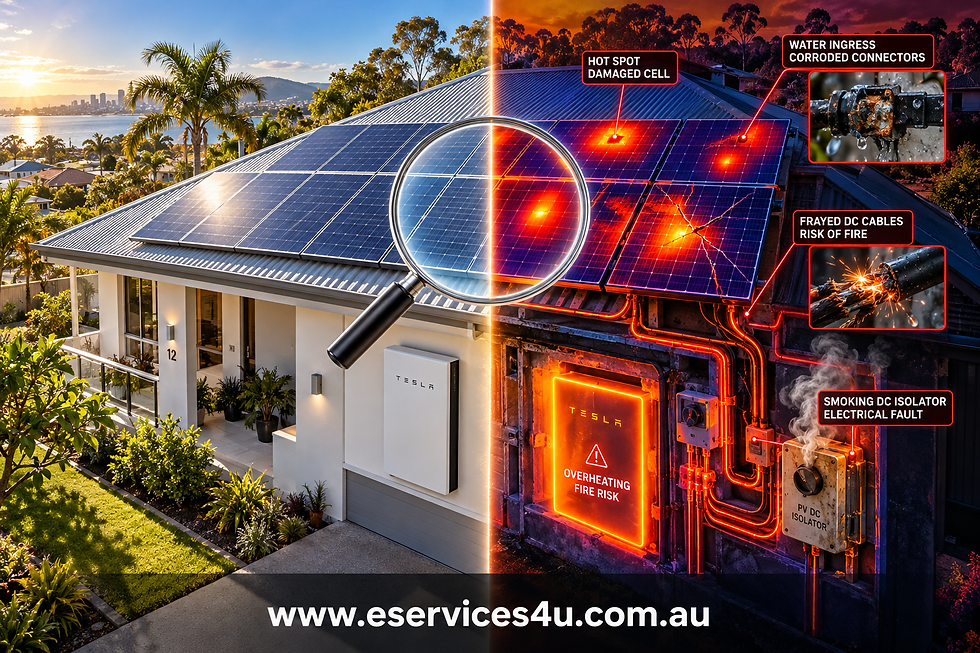
AS/NZS 5033 Explained: Australia’s Core Standard for Solar PV Installation and Safety

If you are developing a commercial solar project, upgrading an industrial facility, or investing in renewable energy assets across Australia, you will constantly hear references to AS/NZS 5033. But what exactly does this standard cover, why did the landmark 5033:2021 revision change the industry, and how does it impact your engineering and compliance workflows?
At EServices4u, we regularly navigate the intersection of Australian Standards and state-based electrical safety laws. Whether you are building a 100kW rooftop system or a utility-scale solar and storage farm, understanding AS/NZS 5033 is essential for preventing catastrophic component failures, avoiding fire risks, and securing grid connection approvals.
Here is a comprehensive breakdown of AS/NZS 5033 explained, backed by current regulatory enforcement data, engineering best practices, and actionable advice for your next project.

What is AS/NZS 5033?
AS/NZS 5033 (Installation and safety requirements for photovoltaic [PV] arrays) is the master Australian and New Zealand standard governing the design, wiring, protection, and isolation of direct current (DC) solar PV circuits.
While AS/NZS 3000 (the "Wiring Rules") governs general electrical installations, Clause 7.3.2 of the Wiring Rules explicitly mandates that all in-scope solar PV installations must comply with AS/NZS 5033. In Queensland, where electrical safety and professional engineering laws are strictly monitored, compliance with AS/NZS 5033 is legally binding for any system being connected to the grid or certified by an RPEQ Electrical Engineer Brisbane.
Game-Changing Updates in AS/NZS 5033:2021
The release of AS/NZS 5033:2021 marked the most significant overhaul of solar safety rules in a decade. Here are the critical changes every project owner and developer must know:
1. The Abolishment of Rooftop DC Isolators
For years, Australia was unique in mandating enclosed DC isolator switches on roofs right next to solar arrays. Unfortunately, due to harsh UV exposure, water ingress, and thermal cycling, these rooftop isolators became the single largest cause of solar-related fires in Australia.
AS/NZS 5033 eliminated the mandatory requirement for rooftop DC isolators. Instead, systems can now utilize a "disconnection point" (such as rated MC4 connectors adjacent to the array) combined with inverter-level load-break disconnectors or string protection boxes. This change dramatically improved long-term fire safety and reduced maintenance headaches for commercial asset owners.
2. Higher DC Voltage Limits for Commercial Systems
To support the booming commercial and utility-scale solar sectors, the standard increased maximum allowable DC voltage limits:
Commercial and Industrial Systems: Can now be designed up to 1500V DC (up from 1000V).
Residential Systems: Expanded from 600V to 1000V DC.
Higher voltage limits allow for longer solar strings, reducing the number of parallel combiner boxes, lowering wiring costs, and improving overall system efficiency. Navigating these 1500V architectures requires advanced Brisbane Solar Engineering oversight and precise voltage-drop calculations.
3. Strict Cable Routing and Segregation Rules
Working in tandem with updated cable standards (such as AS/NZS 3008.1.1), AS/NZS 5033 introduced strict mechanical protection and cable routing rules. To prevent DC cables from collapsing onto firefighters during a building fire, cables running inside a building must now be securely clipped to structural roof elements if within 600mm of the ceiling. Furthermore, strict physical segregation between high-voltage DC lines and AC cables is now explicitly enforced.
Why AS/NZS 5033 Requires Professional RPEQ Oversight in QLD
In Queensland, designing a commercial solar system to AS/NZS 5033 is not a simple "copy-paste" exercise. Under the Professional Engineers Act 2002, any engineering design that involves calculations, voltage temperature coefficient adjustments, or protection sizing for commercial systems (typically 30kW and above) requires RPEQ Certification.
Engaging a qualified Electrical Engineering Consultant Brisbane or a Solar PV Engineering Consultant early in your project lifecycle ensures:
Accurate String Sizing: Calculating maximum open-circuit voltage ($V_{oc}$) during record-cold ambient temperatures to ensure the array never exceeds the inverter's maximum input voltage or the AS/NZS 5033 limits.
Compliant Earthing and Bonding: Ensuring array frames and mounting structures are correctly earthed to prevent electric shock hazards.
Seamless Grid Compliance: Integrating your PV array with inverter protection settings that satisfy both AS/NZS 5033 and network connection standards. A dedicated Grid Compliance Consultant or Grid Connection Consultant will ensure your single-line diagrams (SLDs) pass Energex or Ergon reviews without delay.
Industry Enforcement Data: The Cost of Overlooking Standards
Regulatory authorities and market operators have zero tolerance for outdated or non-compliant equipment. A major industry shakeup recently occurred surrounding Clause 4.3 of AS/NZS 5033, which mandates that all solar PV modules installed in Australia must be qualified to IEC 61215 standards.
Regulatory Crackdown on Module StandardsBecause AS/NZS 5033 references IEC standards without a fixed year, state electrical safety legislation automatically mandates the most recently published version. The Clean Energy Council (CEC) enforced a strict industry-wide transition requiring all solar modules to meet the updated IEC 61215:2021 standard. Panels that failed to meet these stringent new thermal and mechanical testing criteria were stripped from the approved products list. Installing non-compliant modules—even accidentally—results in immediate failure of electrical safety inspections, complete forfeiture of Small-scale Technology Certificates (STCs) or Large-scale Generation Certificates (LGCs), and severe liability for project developers.
This data highlights why you cannot rely on superficial advice from some SEO Brisbane Electrical Engineering Consultant who lacks real-world technical depth. You need a verified Brisbane RPEQ partner who tracks regulatory shifts before they impact your bottom line.
How EServices4u Protects Your Renewable Energy Investments
At EServices4u, we provide end-to-end engineering consultancy that bridges the gap between complex Australian Standards and commercial project execution. Whether you are deploying solar alone or integrating complex energy storage, our RPEQ-certified team delivers rigorous technical rigor.
Our Specialized Consultancy Services Include:
Comprehensive Feasibility: We conduct detailed Solar Feasibility Study and Battery Feasibility Study assessments to model energy yields, financial returns, and spatial layout constraints.
Storage & Grid Integration: Our work as a Battery Energy Storage Consultant in BESS Engineering Australia ensures your battery systems comply with both AS/NZS 5033 (for DC solar inputs) and AS/NZS 5139 (for battery safety).
Design Verification: We perform meticulous Electrical Design Review workflows to catch compliance gaps before procurement begins.
Asset Protection: Acting as your Owner's Engineer Solar or Renewable Energy Engineering Consultant, we provide independent oversight during construction and commissioning.
Complex Infrastructure: If your facility operates an internal grid, our role as an Embedded Network Consultant ensures sub-metering and solar distribution remain 100% compliant.
Investment Security: We execute rigorous Technical Due Diligence Solar audits for institutional investors, banks, and commercial property buyers to verify asset health and standards compliance.
Do not let AS/NZS 5033 compliance hurdles or changing module standards derail your project timeline. Contact EServices4u today to partner with a leading engineering consultancy that ensures your assets are safe, compliant, and optimized for maximum generation.