
South Australia's $17.8 Million StrataCharge: What Shared Solar and Batteries Mean for Queensland Strata Owners

South Australia has opened a $17.8 million package for shared solar and battery systems in strata and community-title properties — the clearest signal yet that apartment living is finally being treated as a solar problem worth solving, not one to leave for later. The program is called StrataCharge. It offers grants for up to half the cost of a shared solar and battery system, capped at $47,500, plus optional zero-interest loans of up to $47,500 to cover the remaining cost. Applications run through project partner Brighte Capital, and the program is co-funded through the Australian Government's Community Solar Banks Program, with the Commonwealth and the state contributing equally.
It is reported that the program was announced on 15 November 2026, and this blog presents the story as reported on that date — not as news from today. The problem it targets is large: it is reported that about 160,000 households — roughly one in 12 South Australians — live in strata properties, where common roofs, shared meters and collective decision-making can prevent residents from installing their own systems. A household in a freestanding house can decide on solar over a weekend. A household in an apartment usually cannot decide anything on its own, because the roof belongs to everyone, the meter belongs to the building, and the decision belongs to the body corporate.
That is why StrataCharge matters beyond South Australia. Queensland has no equivalent strata solar grant program announced as at 15 November 2026, and Queensland strata owners cannot apply for StrataCharge — it is a South Australian program. But the design of the program, the funding model it uses, and the two older programs it follows in New South Wales and Victoria all carry direct lessons for Queensland and Brisbane apartment owners, body corporates, developers and investors. This blog works through what StrataCharge actually offers, what it does not offer, how the money works, what the other states have already shown, and what a Queensland strata owner should check before spending anything.
EServices4U is based in Queensland and serves clients Australia-wide. Where a figure, rebate or rule is time-sensitive, this guide says so — confirm it on the program page, your own connection approval or quote before relying on it.
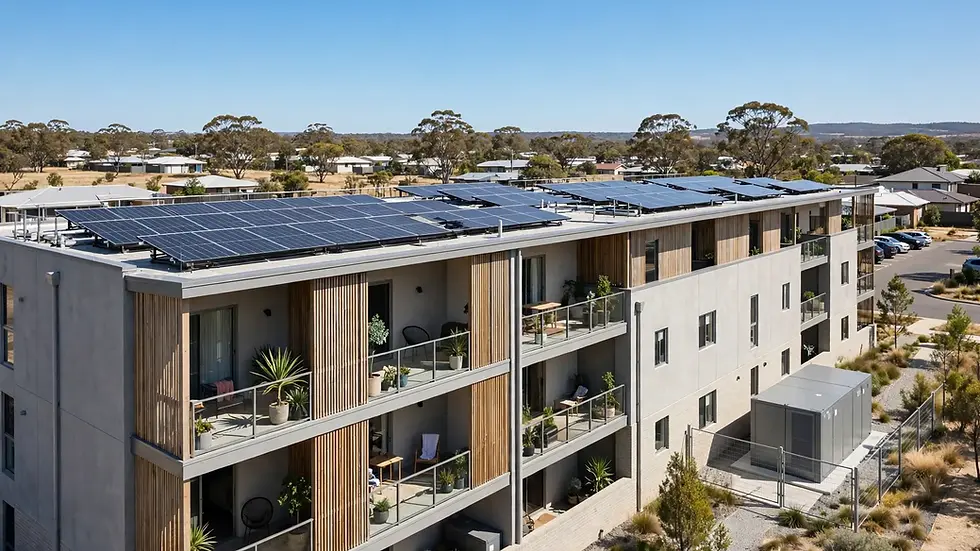
What happened: StrataCharge opens in South Australia
It is reported that South Australia opened StrataCharge on 15 November 2026, a $17.8 million package for shared solar photovoltaic systems and batteries in strata and community-title properties. The program is delivered by the Government of South Australia, and its published page describes the aim in plain terms: to make it easier for a strata community to lower power bills while being part of the renewable energy transition.
The program is aimed at a group that Australian solar policy has largely passed by. Rooftop solar has grown fastest on freestanding houses, where one owner controls the roof, the meter and the decision. Strata residents face a different set of barriers, and StrataCharge is structured around them: money to cut the upfront cost, a loan to cover the rest without interest, guidance on sizing a system for a whole building, and information to support the discussion with a strata corporation.
Applications are handled through project partner Brighte Capital, a finance provider, rather than directly through a government department counter. The program is co-funded through the Australian Government's Community Solar Banks Program, with the Commonwealth and the state governments contributing equally. The federal agreement behind the Community Solar Banks Program in South Australia was signed in August 2025 — more than a year before launch.
The facts: what StrataCharge offers
The table below brings together the verified facts about StrataCharge as published by the Government of South Australia and as reported on 15 November 2026. Anything not in this table — including an application deadline, an uptake figure, or a detailed eligibility rule — is not stated on the program page or has not been confirmed, and this blog does not guess at it.
Fact | Detail |
Program | StrataCharge, delivered by the Government of South Australia |
Total funding | $17.8 million package for shared solar and battery systems in strata and community-title properties |
Grant | Up to 50% of the cost of a shared solar and battery system, up to a maximum grant of $47,500 |
Zero-interest loan | Optional zero-interest loan to pay for the remaining system costs, up to a maximum zero-interest loan of $47,500 |
Guidance included | Guidance on system sizing, information to support discussions with a strata corporation, and application and approval processes |
Applications | Via project partner Brighte Capital — check eligibility and start an application with Brighte Capital |
Co-funding | Co-funded through the Australian Government's Community Solar Banks Program; Commonwealth and state governments contributing equally |
Target households | About 160,000 households in strata properties in South Australia — roughly one in 12 South Australians (reported figure) |
Announced | Reported 15 November 2026 |
Closing date | Not stated on the program page — verify with Brighte Capital before assuming any deadline |
Queensland eligibility | Not eligible — StrataCharge is a South Australian program; no equivalent Queensland program has been announced as at 15 November 2026 |
What the program page does not say matters as much as what it does. No closing date, uptake figure or detailed eligibility list is published on the StrataCharge page — eligibility is checked through Brighte Capital. Do not assume a deadline exists, and do not assume one does not: verify the current position with Brighte Capital or the program page before acting, and treat any date quoted in a sales pitch as unconfirmed until it is checked against the program itself.
Why strata residents have been locked out of solar
Three barriers keep apartment residents out of rooftop solar, and they apply in Brisbane and regional Queensland just as much as in Adelaide. The roof is common property. In a strata building, the roof is usually common property, controlled by the body corporate (in Queensland) or the owners corporation (in some other states). An individual owner cannot fix panels to it or alter the building's electrical infrastructure without the body corporate passing a resolution — so a solar decision needs a meeting, a vote, a budget and a maintenance plan. The meter belongs to the building, not the apartment. A strata building has individual apartment meters, common-area meters, and often a shared supply arrangement designed decades before solar existed. Sharing one rooftop system's output fairly among many apartments needs metering, allocation and billing arrangements that a standard residential installation does not. The split incentive. In many buildings, the people who would pay for the system are not the same people who would see the savings: landlords may own apartments they do not live in, tenants pay the bills but cannot approve works, and owner-occupiers may sell before a system has paid for itself. A grant covering up to half the cost shortens the distance between the cost and the benefit for everyone involved.
How the money works: grants and zero-interest loans
StrataCharge combines two funding tools — a grant and an optional zero-interest loan. The grant: up to 50% of the cost of a shared solar and battery system, up to a maximum grant of $47,500. Both numbers matter. For a system costing less than $95,000, the grant covers half; above $95,000, the $47,500 cap means it covers less than half. Ask for the grant as a dollar amount on your own quote, not a percentage, and check whether the "cost" includes the battery, inverter, metering and allocation equipment, switchboard work and installation — or only the panels.
The zero-interest loan: an optional loan to pay for the remaining system costs, up to a maximum of $47,500, at zero interest. A strata community is not obliged to borrow, and the loan is structured to cover the balance after the grant, not to stack on top of a full-price system. A zero-interest loan still has to be repaid: verify the repayment terms and period, who the borrower is, and what happens if an owner sells before the loan is repaid, with Brighte Capital before committing — none of those details is stated on the program page.
The zero-interest loan: an optional loan to pay for the remaining system costs, up to a maximum of $47,500, at zero interest. The word "optional" matters: a strata community is not obliged to borrow. The word "remaining" matters too: the loan is structured to cover the balance after the grant, not to stack on top of a full-price system. A zero-interest loan still has to be repaid, and the repayment terms, the repayment period, who the borrower is (the body corporate or individual owners), and what happens if an owner sells before the loan is repaid are all questions to verify with Brighte Capital before committing — none of those details is stated on the program page.
Illustrative arithmetic — not a quote. The table below shows how the grant and loan caps interact at three illustrative system costs. These are arithmetic examples worked from the published caps only. They are not prices, not quotes, and not a promise of what any building will pay: real system costs depend on the roof, the system size, the battery, the switchboard, the metering arrangement and the installer.
Illustrative system cost | Grant (50%, capped at $47,500) | Remaining cost | Zero-interest loan available (up to $47,500) | Balance to fund from other sources |
$60,000 | $30,000 | $30,000 | Up to $30,000 | $0 if the full loan is taken |
$95,000 | $47,500 | $47,500 | Up to $47,500 | $0 if the full loan is taken |
$150,000 | $47,500 (capped) | $102,500 | Up to $47,500 | $55,000 |
Read the table carefully. At $60,000 and at $95,000, the grant plus the maximum loan could in principle cover the whole system cost — but only if the loan is approved, only if the building qualifies for the maximum in both cases, and only if the "cost" used for the grant calculation matches the quoted price. At $150,000, the caps bite and $55,000 must come from elsewhere — reserves, a special levy, or another funding source. Verify the grant and loan amounts in writing for your own building and quote, and ask who carries the risk if the grant is less than assumed.
What the funding does not do. A grant and a loan cut the upfront cost; they do not guarantee a saving, a payback period or a bill reduction. The value of a shared system depends on how much solar is used on site, what the building pays for grid electricity, what it is paid for exports, how the battery is operated, and how the savings are shared. Ask for those figures to be modelled on your own load and tariff data, not on a generic example from another building.
How a strata community applies, and what the program does not cover
Start with Brighte Capital. The Government of South Australia's StrataCharge page directs interested strata communities to learn more, check eligibility and start an application with project partner Brighte Capital. Check eligibility first, then discuss sizing and costs, then take the proposal to the strata corporation. A community that signs a contract before checking eligibility risks committing to a system that the program will not fund.
Use the guidance the program offers. StrataCharge includes guidance on system sizing, information to support discussions with a strata corporation, and application and approval processes. That guidance exists because the hardest part of a strata solar project is usually not the panels — it is the conversation inside the building. Ask Brighte Capital what sizing guidance and discussion material is available, and use it before calling a meeting, not after. Expect a process, not a same-day approval. In Queensland, published guidance says an extraordinary general meeting to approve shared solar requires at least 21 days' notice — verify that figure for your own scheme against the scheme's by-laws and the relevant Queensland legislation before a meeting is called.
It is for shared systems, not individual apartment systems. The grant is for one shared solar and battery system serving the building — not individual panels on balconies or individual batteries in apartments. It does not remove the body corporate decision. The program provides information to support discussions with a strata corporation; it does not override the corporation, waive a vote, or approve a system on the building's behalf. It also does not set the system size, the installer, or the price. It does not apply in Queensland. StrataCharge is a South Australian program for South Australian strata properties. A Queensland body corporate cannot apply for it, and a Queensland installer cannot claim it on a Queensland building's behalf. What Queensland can learn from it is the model — and what Queensland owners can do now, without a grant, is covered later in this blog.
The national picture: New South Wales and Victoria got there first
South Australia is not the first state to fund shared solar for apartments. Victoria and New South Wales already run programs for shared solar in apartment buildings, and their published results are the best available guide to what StrataCharge might achieve. The figures below are published industry guidance, reported in November 2026, and are presented as reported figures, not as government-confirmed totals: verify them against the relevant state program pages before relying on them in a business case.
Program | Reported funding | Reported progress | Reported end date |
New South Wales shared solar for apartments | About $30 million | Roughly 35% paid out in about 18 months | Ends December 2026 |
Victoria shared solar for apartments | About $32 million | Roughly 25% paid out in about 2.5 years | Expires June 2027 |
South Australia — StrataCharge | $17.8 million | Opened 15 November 2026; no uptake figure published yet | Not stated on the program page |
New South Wales moved fast, then ran out of time. It is reported that the New South Wales program started in February 2025 — about a year after Victoria's — and had paid out roughly 35% of its approximately $30 million in about 18 months, suggesting strong demand once the program opened. But the same reporting says the program ends in December 2026, only weeks after StrataCharge opened. A program that pays out a third of its funding in 18 months and then closes has demonstrated demand without necessarily meeting it. For South Australia, the lesson is that a start date and a funding total are not the same as a funded pipeline.
Victoria moved first and moved slowly. It is reported that Victoria's program, at about $32 million, had paid out roughly 25% in about 2.5 years, and that it expires in June 2027. A quarter paid out in two and a half years points to friction in the process, not a lack of demand. Published industry guidance points to higher strata voting thresholds in Victoria as one barrier — a small number of objections can stall a building-wide upgrade. The lesson is that the grant is only half the job: voting rules and building-level decision-making matter just as much.
It is reported that industry guidance calls for the New South Wales and Victorian programs to be kept funded rather than allowed to lapse, for equivalent support to be extended to Queensland and South Australia, and for strata voting thresholds to be lowered or clarified. South Australia has now answered the second of those calls for its own state. Queensland has not — yet. Both older programs are closing within months of StrataCharge opening, so the national picture in mid-2027 could be a single open program in South Australia, plus the ACT, and nothing in the two largest states. For a Queensland reader, the expiry dates are a reminder: a program that exists today may not exist when your building is ready.
What this means for Queensland: no equivalent program — yet
The plain position. As at 15 November 2026, no equivalent Queensland strata solar grant program has been announced. Queensland strata owners cannot apply for StrataCharge, the New South Wales program, or the Victorian program. A Queensland body corporate that wants shared solar today must fund it from its own resources — reserves, a special levy, a loan, or a combination.
Why Queensland is the obvious next candidate. Queensland has the roof space, the sunshine and the apartment stock to make shared solar work, particularly in Brisbane, the Gold Coast and the Sunshine Coast. It also has the same barriers South Australia identified: common roofs, shared meters and collective decision-making. Published industry guidance explicitly calls for equivalent support to be extended to Queensland — but a call for a program is not a program. A Queensland body corporate should not delay a project it wants on the assumption that a grant will appear, and should not assume a future Queensland program would match StrataCharge's terms.
What Queensland strata owners can do now. The absence of a grant does not mean the absence of options. The steps are the same with or without a grant: confirm who owns the roof and what resolution is needed, verifying the position against the scheme's by-laws; allow time for the meeting — published guidance says an extraordinary general meeting to approve shared solar in Queensland requires at least 21 days' notice; get interval electricity data for the common areas and, where possible, the building as a whole before accepting a system size; decide whether the system will serve common areas only — the simplest model, where the body corporate pays and saves with no allocation arrangement needed — or every apartment, which is more valuable but needs metering and a fair way to share the output; check the connection with Energex in South East Queensland or Ergon Energy in regional Queensland, which approves the connection and sets the export limit, before signing a construction contract; and model the money without a grant, so a future grant would improve numbers that already make sense.
Brisbane buyers: the apartment question to ask before you buy. For a Brisbane buyer considering an apartment, ask the seller or the body corporate before signing a contract: does this building have shared solar, has it considered it, and is there a plan — or a fund — for it? A building with a shared system, or with a credible plan for one, is a different proposition from a building where the question has never been raised. A pre-purchase technical review can check whether the roof, switchboard and metering would support a shared system.
The technology: how one rooftop system serves many apartments
Shared solar is a design task, not a product. The most widely used approach connects a single rooftop solar system to every apartment and the common areas, and shares the solar fairly among residents. The best-known example in Australia is Allume Energy's SolShare. The manufacturer's published figure is that SolShare is installed in apartment buildings across Australia benefiting more than 13,000 individual apartments, including a Queensland complex. That is the manufacturer's published figure, not an independently verified count — but it shows the technology is installed and operating, including in Queensland.
Three models, in increasing order of complexity. Common-area solar only: panels power shared loads — lifts, lighting, pool pumps, car park ventilation. The body corporate pays and saves, with no allocation needed. The limitation is scale: common-area loads are often a small share of a building's total electricity use. Shared solar to every apartment: one rooftop system serves every apartment and the common areas, with the output shared fairly among residents. This is the model SolShare uses, and it is the model StrataCharge is designed to fund. It delivers a larger system and larger savings, but it needs metering and allocation equipment, a fair sharing arrangement, and a clear statement of who pays and who benefits — including tenants, who pay the bills but do not own the building. Embedded networks: the building buys power in bulk and on-sells it to residents, usually with solar and sometimes a battery. It is the most complex model: embedded networks are regulated, with registration, exemption and consumer protection obligations that the body corporate must meet or outsource. Do not enter one without independent advice on the regulatory obligations.
Batteries in strata. StrataCharge funds shared solar and battery systems together, and the battery is the part of the package that most changes the value. A shared battery can store daytime solar for evening use, shave the building's evening peak, and provide a degree of backup for common-area loads. Size it from the evening load, not the roof size, and get the usable energy, discharge power and served loads in writing. Ask for the allocation method in writing too — how much solar each apartment receives, how it is measured, and how disputes will be handled — before approving a shared system.
The federal context: batteries, certificates and timing
The Cheaper Home Batteries Program — and the shared-storage gap. The Federal Cheaper Home Batteries Program began on 1 July 2025, and it is reported that more than 600,000 batteries had been installed under the program by 9 November 2026. That is a residential program, for home batteries, and this blog does not claim it already covers shared strata systems. What is reported is that industry voices are calling for the program to be amended so that apartment buildings can more easily access shared storage and the extra savings that come with it. That call has not been answered yet, as far as published information shows. Verify any battery incentive against the program's published rules, and do not let a tenderer bundle a home-battery discount into a strata quote without showing the eligibility basis.
The SRES mid-scale expansion — 1 October 2026. From 1 October 2026, eligible solar systems from 100 kW to 1 MW can earn small-scale technology certificates (STCs) under the expanded Federal Small-scale Renewable Energy Scheme — a band many strata and commercial systems sit in. There is a timing catch. As at 15 November 2026, Clean Energy Regulator STC applications for the mid-scale band were still not open, and are expected to open in mid-to-late November 2026. Check the Clean Energy Regulator's mid-scale solar page before signing. The government headline estimate is that the expansion could cut around 20% off the upfront cost of a medium commercial system — an estimate, not a fixed rebate and not a promise for any specific building.
The STC step-down — 1 January 2027. From 1 January 2027, the STC deeming period for small-scale solar drops from five years to four years, and the battery STC factor drops from 6.8 to 5.7. A building installing before that date may claim under the current deeming; one installing after it will claim less, all else being equal. That is a timing factor, not a reason to rush a poor design. Any proposal quoting an STC value should state which deeming period it relies on and what the value would be under the 1 January 2027 figures.
What this means for you
For investors and developers. A strata program that funds shared solar and batteries changes the value of a building. For a developer, a building designed with shared solar from the start — roof space reserved, switchboard capacity allowed for, metering designed for sharing — is a different product from a building where solar is retrofitted later at greater cost and greater disruption. A developer in Queensland should be asking whether the design allows for a shared system, the roof is suitable, the switchboard has space, and the metering is designed for allocation — now, even without a Queensland grant, because buildings designed today will compete in a market where shared solar is increasingly expected. Verify the answers against the design documents, not against a marketing brochure.
For commercial and industrial buyers. The same shared-solar technology and the same SRES mid-scale expansion apply to commercial buildings with multiple tenancies — a shopping centre, an industrial estate, a commercial building with several tenants faces the same sharing and allocation questions as a residential strata building. The STC changes described above also apply to commercial systems in the 100 kW to 1 MW band, and a commercial buyer signing now should be asking the same questions about STC applications and deeming periods as a strata community. The connection rules are the same too: the distributor approves the connection and sets the export limit before a construction contract is signed.
For homeowners — and for apartment owners in particular. If you own an apartment, StrataCharge is not available to you unless your apartment is in South Australia — but the story still changes what you should ask. Ask your body corporate whether shared solar has been considered, whether a feasibility assessment has been done, and whether there is a plan or a fund for it. If you are buying an apartment, ask the same questions before you sign, and consider a pre-purchase technical review of the building's solar readiness alongside the usual building and pest checks. If you own a freestanding house, the federal battery program and the SRES changes apply to you directly — but do not assume a home-battery incentive applies to a shared strata battery.
For Queensland and Brisbane buyers — the section that matters most. Queensland has no equivalent program, and that fact should shape — not stop — a Queensland strata decision. A Brisbane body corporate that wants shared solar should proceed on its own figures, using the StrataCharge model as a benchmark: what would this system cost, what would a 50% grant have been worth, and does the project still make sense without it? If it does, the building is not dependent on a future announcement. A Brisbane apartment buyer should ask whether the building has a shared-solar plan, and a Brisbane developer should be designing for shared solar now, because the buildings that are ready will be the first to benefit if and when Queensland follows South Australia. Verify the connection and export position with Energex or Ergon Energy, and confirm your scheme's meeting requirements before calling a vote.
What EServices4U would check independently
A grant does not remove the need for an independent check — a poorly designed subsidised system is still a poor system. The checks below are the ones EServices4U would apply to any shared solar and battery proposal.
Is the system sized from the building's real load? Ask for interval electricity data for the common areas and the building as a whole, and check the system size follows from that load, not from the roof area or a generic assumption.
Does the grant and loan arithmetic match the quote? Check the grant figure as a dollar amount, not a percentage, and check whether the "cost" it applies to includes the battery, the inverter, the metering and allocation equipment, the switchboard work and the installation. Check the loan terms with Brighte Capital, and who carries the risk if the grant is less than assumed.
Is the sharing arrangement fair and stated in writing? Ask for the allocation method: how much solar each apartment receives, how it is measured, how tenants are treated, and how disputes will be handled. If the proposal cannot state this plainly, the design is not ready for a vote.
Has the connection been approved? Confirm the connection approval, the export limit and any dynamic export or curtailment arrangement in writing from the distributor — Energex in South East Queensland, Ergon Energy in regional Queensland, or SA Power Networks in South Australia — before signing a construction contract.
Is the STC position stated with its risks? Ask the tenderer to state the STC value, the deeming period it relies on, what the value would be under the 1 January 2027 step-down, and who carries the risk if mid-scale applications do not open as expected.
Is the battery sized to the evening load? Ask for the evening load the battery must cover, the usable energy, the continuous discharge power, and the state-of-charge window relied on — and check whether any battery incentive claimed in the quote actually applies to a shared strata battery.
Is the roof, switchboard and metering ready? Verify the roof's structural assessment and wind-region rating, the switchboard and busbar ratings against the existing load plus the new inverters, and the metering arrangement for sharing output. Ask who signs each assessment and whether any upgrade is included in the quote or will appear later as a variation.
What does the contract actually promise? Check the tender for clear milestones, a measurable performance expectation, warranty terms, and what happens if the system underperforms. If a tenderer resists an independent review, ask why.
These checks map to EServices4U's fixed-fee services: a solar and battery feasibility assessment from $299 can test whether shared solar suits a specific building before tender; a Commercial Infrastructure Assessment / RPEQ & RPEV SLD Sign-Off from $495 can review the single-line diagram, protection and connection arrangement for a larger shared system; a residential quote review from $149 can check an individual owner's quote; and Home Owner's Engineer services from $599 can provide independent engineering support through design review and installation checks. Confirm scope and qualifications for each engagement before proceeding.
How This Works for Both Sides
For the strata community: the value is lower common-area costs, lower bills for residents where the sharing arrangement passes savings through, a building that is easier to sell and easier to rent, and a system designed for the building rather than copied from a house. The community's side of the bargain is to provide good data — interval electricity data, roof and switchboard information, and the scheme's by-laws — and to maintain the system as specified. For the contractor and the program partner: the value is a well-defined scope, a client that has provided interval data and a clear brief, and a project that can be delivered without variations caused by missing information — so the job can be priced properly and stood behind. A contractor that has to guess the load shape, roof structure or switchboard capacity cannot price the job properly.
Frequently asked questions
What is StrataCharge?
StrataCharge is a $17.8 million South Australian Government package for shared solar and battery systems in strata and community-title properties, reported as opened on 15 November 2026. It offers grants for up to 50% of the cost of a shared solar and battery system, up to a maximum grant of $47,500, plus optional zero-interest loans of up to $47,500 to pay for the remaining costs. Applications run through project partner Brighte Capital, and the program is co-funded through the Australian Government's Community Solar Banks Program.
Can Queensland strata owners apply for StrataCharge?
No. StrataCharge is a South Australian program for South Australian strata properties. Queensland strata owners cannot apply for it. As at 15 November 2026, no equivalent Queensland strata solar grant program has been announced. Queensland body corporates must currently fund shared solar themselves, or wait to see whether Queensland announces an equivalent program.
How much can a strata community actually receive?
The grant covers up to 50% of the cost of a shared solar and battery system, capped at $47,500. The optional zero-interest loan covers the remaining costs, also capped at $47,500. For a system costing $95,000 or less, the grant plus the maximum loan could in principle cover the full cost — but only if the building qualifies for the maximum in both cases and the loan is approved. For a larger system, the caps mean the community must fund the balance itself.
Is there a closing date for applications?
No closing date is stated on the Government of South Australia's StrataCharge page. Do not assume a deadline exists, and do not assume one does not: verify the current position with Brighte Capital or the program page before acting, and treat any date quoted in a sales pitch as unconfirmed until it is checked against the program itself.
How does shared solar actually work in an apartment building?
One rooftop system serves every apartment and the common areas, with the output shared fairly among residents. Technology such as Allume Energy's SolShare connects a single rooftop system to every apartment and the common areas and allocates the solar among residents, owner-occupiers and renters alike. The manufacturer's published figure is that SolShare is installed in apartment buildings across Australia benefiting more than 13,000 individual apartments, including a Queensland complex.
What have New South Wales and Victoria shown?
It is reported that New South Wales has a program of about $30 million, started in February 2025, with roughly 35% paid out in about 18 months, ending in December 2026; and Victoria has a program of about $32 million, with roughly 25% paid out in about 2.5 years, expiring in June 2027. New South Wales suggests demand is strong once a program opens; Victoria suggests building-level approval processes can slow payout significantly.
Does the federal Cheaper Home Batteries Program cover shared strata batteries?
The program, which began on 1 July 2025, is for home batteries, and this blog does not claim it already covers shared strata systems. It is reported that industry voices are calling for the program to be amended so apartment buildings can more easily access shared storage. Verify any battery incentive against the program's published rules. It is reported that more than 600,000 batteries had been installed under the program by 9 November 2026.
We are a Queensland body corporate. What should we do now?
Proceed on your own figures. Confirm who owns the roof and what resolution is needed, allow time for the meeting — published guidance says an extraordinary general meeting to approve shared solar in Queensland requires at least 21 days' notice, which should be verified for your own scheme — get interval load data before accepting a system size, decide whether the system will serve common areas only or every apartment, confirm the connection and export limit with Energex or Ergon Energy, and model the money without assuming a future grant.
Get an independent check before you sign
EServices4U provides independent solar and electrical engineering advice for Queensland and Australian strata communities, body corporates, developers, investors and homeowners. We do not sell solar installations and we do not receive installer commissions, so our reviews are independent of any tenderer.
Start with a free 15-minute consultation to talk through your tender, system, building, or project and find out which fixed-fee review fits, if any. Call/WhatsApp 0480 001 498 or email growthpartner@eservices4u.com.au. No obligation, and it does not include a written report.
Residential quote review — from $149: a fixed-fee independent review of a residential solar or battery quote. See packages and pricing.
Solar & battery feasibility — from $299: an independent assessment of whether solar and batteries suit your building, including load-shape, tariff, export and sharing considerations. See packages and pricing.
Home Owner's Engineer — from $599: independent engineering support for a residential project, from design review through to installation checks. See Owner's Engineer services.
Commercial Infrastructure Assessment / RPEQ & RPEV SLD Sign-Off — from $495: an independent commercial assessment, including single-line diagram review and sign-off where applicable, for strata, commercial and industrial shared-solar projects. See packages and pricing and meet the team.
To start, visit the EServices4U home page or request a quote review, or call/WhatsApp 0480 001 498 or email growthpartner@eservices4u.com.au. Bring your interval data, your building's by-laws, your connection approval and your tender.


Comments