BESS Design Mistakes That Can Cost too much: Lessons from an Owner's Engineer Perspective

Updated: Jul 20
The deployment of Battery Energy Storage Systems (BESS) is accelerating at a record pace across Australia. As the grid transitions, businesses and developers are rushing to install commercial storage to stabilize power, shave peak loads, and increase renewable consumption.
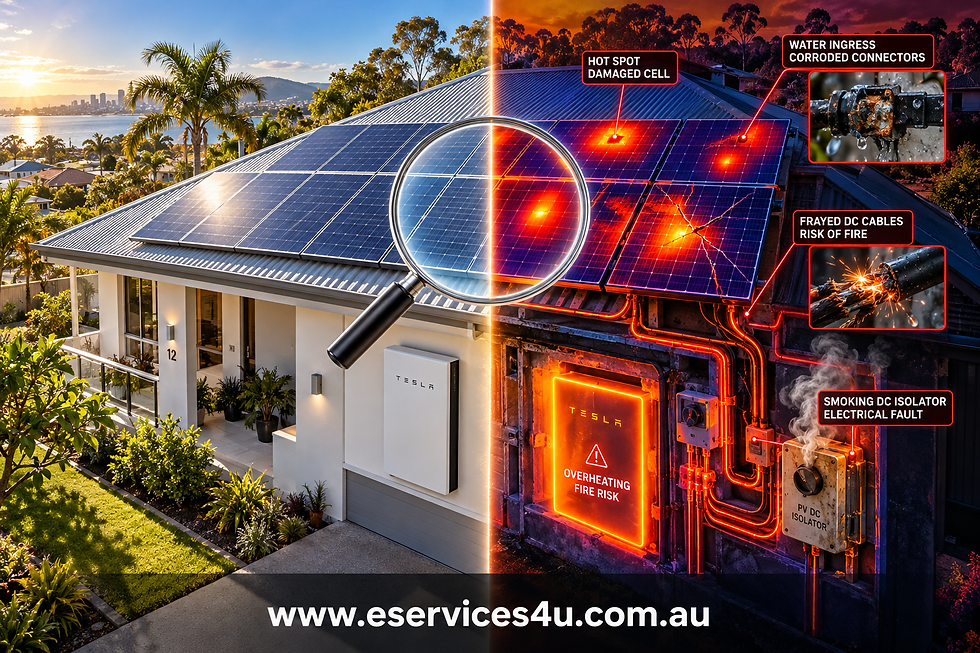
However, designing a robust, legally compliant, and high-performing BESS is incredibly complex. A minor miscalculation during the design phase can lead to thermal runaway, voided warranties, rejected grid applications, or catastrophic system failure.
At EServices4u, we frequently audit, review, and fix failing battery projects. Whether you are developing a new utility-scale asset or retrofitting storage onto a commercial site, avoiding these common engineering pitfalls is vital to the success of your investment.
Here are the most critical mistakes in BESS design and how specialized engineering oversight can prevent them.

1. Skipping a Comprehensive Battery Feasibility Study
One of the most expensive mistakes developers make is sizing a battery based purely on peak load guesswork rather than data-driven load profiling.
Over-sizing: Calculating capacity by simply multiplying "backup duration by peak load" without factoring in load diversity. This results in millions of dollars of wasted capital expenditure on idle capacity.
Under-sizing: Slashing capacity simply to hit a rigid capital expenditure target. In off-grid or embedded networks, this can lead to system collapse during consecutive days of low renewable generation.
Before procuring hardware, engaging a dedicated Battery Energy Storage Consultant to run a comprehensive Battery Feasibility Study—paired with a broader Solar Feasibility Study if charging from PV—is non-negotiable. This ensures the system is economically viable and technically capable of meeting extreme weather scenarios.
2. Ignoring Depth of Discharge (DoD) and Long-Term Degradation
Batteries are not static assets; their chemical capacity degrades with every cycle. A common novice error is using 100% of a battery’s nameplate capacity in the energy yield modeling.
Lithium-ion batteries typically have a safe Depth of Discharge limit of 80–90%. Furthermore, over a 10-to-15-year lifecycle, a BESS will lose 20–30% of its initial capacity. If you size a system based on its "Day One" capacity, your asset will fail to meet your energy requirements by year seven. A qualified Renewable Energy Engineering Consultant will design the system for its end-of-life capacity, ensuring your investment remains profitable for the duration of the project.
3. Poor Thermal Management and Spacing Design
According to recent insurance data, thermal events and poor airflow design are the primary drivers of BESS failures. Heat is the enemy of battery storage. If localized temperatures inside a container are not properly managed via liquid cooling or advanced HVAC systems, it rapidly accelerates cell degradation and increases the risk of thermal runaway.
Furthermore, spacing is critical. Underwriters and regulatory bodies are scrutinizing site layouts heavily. If battery containers are placed too close to one another or too near habitable buildings, you risk being completely uninsurable.
4. Falling Behind the Latest Regulatory Mandates (AS/NZS 5139)
Battery compliance in Australia is strict and rapidly evolving. Relying on outdated standard revisions is a guaranteed way to fail an Electrical Design Review.
2026 Industry Data & Enforcement Alert:- The AS/NZS 5139:2019 And 1:2025 Mandate As of June 19, 2026, full compliance with Amendment 1 of the AS/NZS 5139 standard became strictly mandatory for all electrical licence holders. This amendment overhauled location restrictions, clearance requirements, and mandated specific cell short-circuit current calculation methods.
Furthermore, the Clean Energy Council is enforcing the transition to the new SA TS 5398 safety requirements. Approvals under the old Best Practice Guide will be entirely phased out, meaning any BESS design must now specify equipment certified to these rigorous new safety and chemistry standards.
5. Inadequate Grid Compliance and Substandard BMS
Your Battery Management System (BMS) is the brain of your asset. Cutting costs by utilizing a BMS without critical features—like overvoltage protection and insulation monitoring—turns your BESS into a major liability.
Connecting these large-scale systems to the network requires complex protection relay settings and power quality logging. You need an expert Grid Connection Consultant and a Grid Compliance Consultant to ensure your system meets the stringent requirements of local distribution network service providers (DNSPs).
The EServices4u Advantage: Real Engineering, Not Gimmicks
When millions of dollars are on the line, you cannot afford to trust your project to some SEO Brisbane Electrical Engineering Consultant who lacks practical field experience. You need specialized, certified oversight.
As a leading Electrical Engineering Consultant Brisbane, EServices4u provides full-spectrum BESS Engineering Australia services. We take the guesswork out of complex energy storage. Whether you need a leading Brisbane Solar Engineering expert to integrate a battery into your PV farm, or require strict RPEQ Certification to satisfy grid operators, our team is equipped to deliver.
How we protect your project:
Owner's Engineer Solar & BESS: Providing unbiased Technical Due Diligence Solar and storage analysis before you sign EPC contracts.
Embedded Network Consultant Services: Navigating complex sub-metering and BESS integration within commercial estates.
RPEQ Electrical Engineer Brisbane: Legally binding Brisbane RPEQ sign-offs for Single Line Diagrams, protection settings, and AS/NZS 5139 compliance.
Solar PV Engineering Consultant: Ensuring seamless integration between your generation and storage assets.
Do not let design flaws derail your energy transition. Contact EServices4u today to ensure your BESS project is safe, compliant, and engineered for maximum profitability.